Contact Us

Blog
October 6, 2026
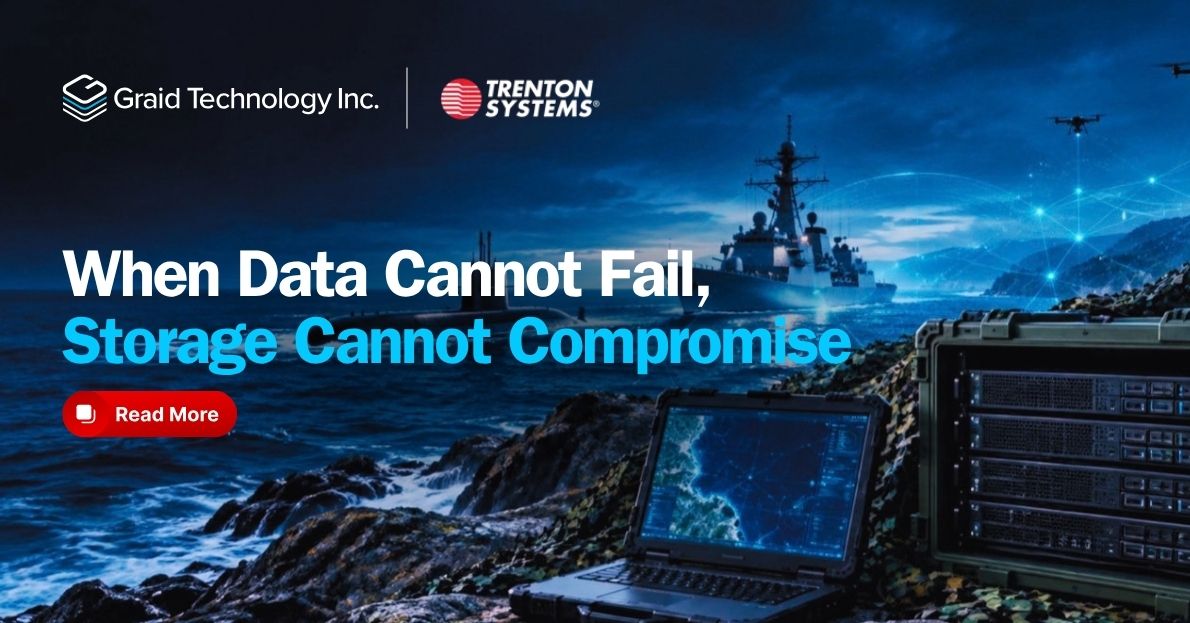
When Data Cannot Fail, Storage Cannot Compromise
In defense and mission-critical environments, data is not simply an operational asset. It supports situational awareness, mission continuity, and time-sensitive decision-making, often where connectivity is constrained and environmental conditions are unforgiving. A platform deployed aboard a ship, submarine, aircraft, or remote edge site must preserve and process vital data while withstanding shock, vibration, temperature extremes, all within tight space constraints and limited power budgets.
The Rugged Edge Is a Storage Challenge
Traditional enterprise infrastructure was not built for this reality. Defense systems need compact, high-density platforms that combine rugged construction with the performance to ingest, protect, analyze, and move data locally.
Trenton Systems addresses this need with the TRS14-18.5, an ultra-rugged, short-depth 1U server based on Intel Xeon6 architecture. The system combines all-aluminum construction, PCIe Gen5 expansion, removable NVMe storage, and modular compute options in an 18.5-inch-deep design. It supports harsh edge operation from -40°C to 50°C and is engineered for demanding shock and vibration environments.
These capabilities rest on a foundation of U.S.-based engineering and production trusted by government and defense customers for mission-critical applications. Trenton Systems servers are fully designed and manufactured in the USA, not simply assembled domestically. Design, manufacturing, assembly, testing, and support take place in the United States, giving mission-critical integrators a domestically engineered and produced computing platform backed by a proven track record supporting U.S. military and government programs.
Resiliency Designed Around the Mission
No two deployed defense workloads are alike. Sensor fusion, radar processing, intelligence collection, cross-domain traffic management, communications, and image analysis each place different demands on local storage. Yet all share one critical requirement: data resilience to keep vital information protected and available when the mission depends on it.
That is why the Trenton Systems platform can integrate both VROC™ by Graid Technology and SupremeRAID™.Rather than forcing one RAID architecture onto every deployment, system designers can choose the Graid technology that best fits their balance of performance, capacity, resiliency, and deployment requirements.
- VROC™ by Graid provides CPU-native, bootable NVMe RAID for systems that need dependable boot and data protection without adding a dedicated RAID card.
- SupremeRAID™ adds dedicated GPU-accelerated RAID for storage-intensive environments where sustained throughput and low latency are mission requirements.
Used together in a supported configuration, the two technologies address complementary needs: VROC™ by Graid protects boot and operating system volumes, while SupremeRAID™ provides high-performance RAID resilience for mission data. For example, system designers can use VROC™ by Graid for a mirrored RAID 1 boot volume and SupremeRAID™ for a separate, performance-critical NVMe data array. This approach combines resilient boot storage with accelerated data protection in a single server, allowing each storage tier to use the RAID architecture best suited to its role.
Built for High-Density NVMe
For capacity- and bandwidth-intensive deployments, Trenton Systems has demonstrated a rugged storage-server configuration pairing a SupremeRAID™ card with PCIe Gen5 NVMe storage and dual 400GbE networking. The short-depth 1U architecture is designed to scale to nearly 1 PB of raw storage, exceptional density for environments where size, weight, power, and cooling constraints matter as much as performance.
The same modular platform can support GPU or FPGA acceleration, providing a compact foundation for applications such as high-end radar, sensor fusion, software-defined radio, and image processing. This helps integrators tailor a common COTS platform to the mission instead of designing a distinct system from the ground up for every use case.
Secure Storage Starts at the Drive
Performance and physical resilience are only part of the requirement. Many defense deployments also need a deliberate security architecture that protects sensitive data at rest.
When configured with appropriateCSfC-certified self-encrypting drives, the platform can support solution designs aligned with the NSA Commercial Solutions for Classified program. Onboard TPM 2.0 also provides a hardware root of trust that can be incorporated into a broader defense-in-depth strategy. Final CSfC eligibility depends on the complete system design, selected components, integration, and applicable program requirements.
What This Means For You
Mission systems should not have to choose between ruggedization, capacity, data protection, and performance. Trenton Systems provides a purpose-built 1U server platform, fully designed and manufactured in the USA; Graid Technology adds flexible RAID capabilities through VROC™ by Graid and SupremeRAID™. Together, they give defense integrators a COTS-based storage foundation for locations where data is valuable, conditions are extreme, and failure is not an option.
With Trenton Systems’ rugged architecture, you can tailor NVMe storage to the performance, capacity, and protection requirements of each deployment. Use VROC™ by Graid for resilient boot storage, SupremeRAID™ for high-performance data protection, or both in the same server to combine boot-volume redundancy with accelerated mission-data resilience.
Connect with Graid Technology and Trenton Systems to explore a configuration built for your mission.
News & Resources
Defense systems at the rugged edge need compact servers that can protect and process mission data in extreme conditions. See how Trenton Systems uses VROC™ by Graid Technology and SupremeRAID™ in its U.S.-built TRS14-18.5 1U server to combine resilient boot storage with GPU-accelerated data protection.
.jpg)
Graid Technology will showcase SupremeRAID™ AE and Supreme JBOF at Cypher 2026 in Bengaluru, October 7–9. Explore GPU-accelerated NVMe storage and protected KV cache offloading for AI workloads from server to edge.
September 14, 2026
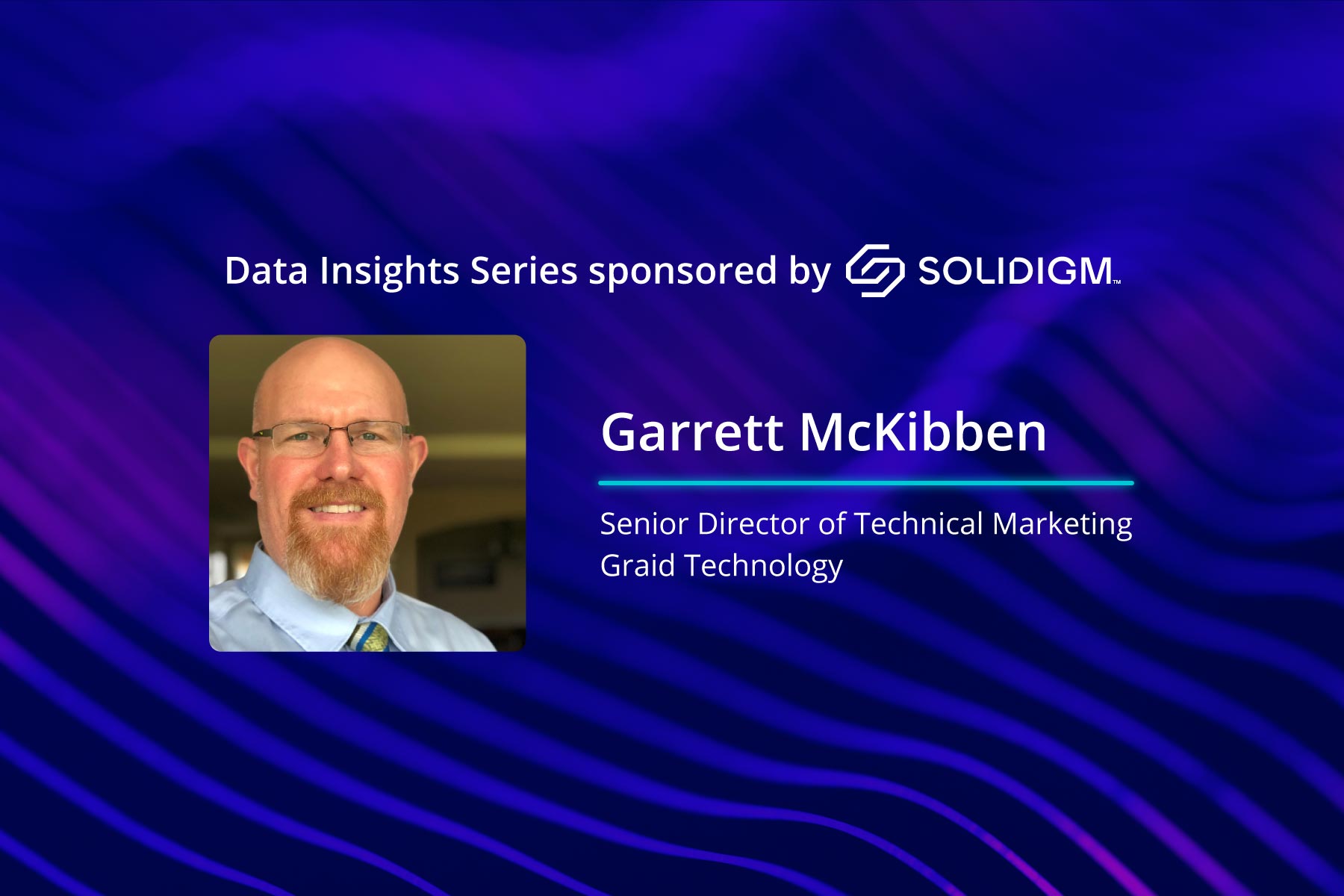
Breaking the KV Cache Inference Wall — Solidigm Data Insights Podcast, Featuring Graid Technology
"You've got a four-lane highway, and to get to your storage, you have to go down to a one-lane bridge." Garrett McKibben joins Solidigm on TechArena's Data Insights podcast to unpack why KV cache overflow is choking AI inference.