Contact Us


Whitepaper
November 13, 2026
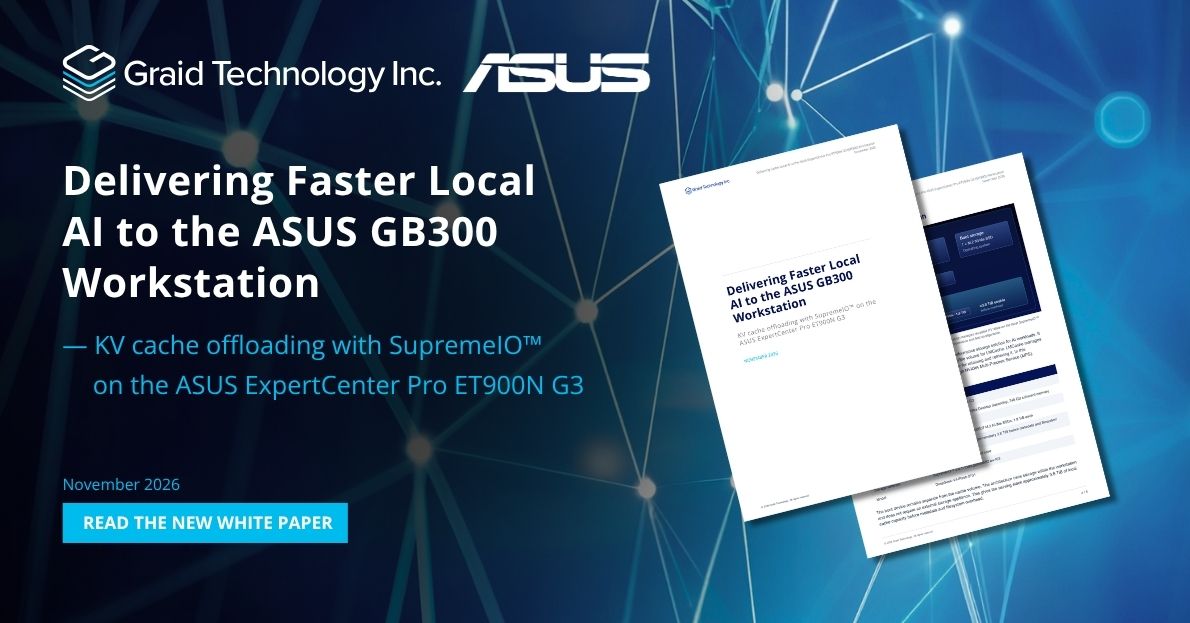
Delivering Faster Local AI on ASUS Workstations with SupremeIO™
Read the White Paper to Learn How SupremeIO™ Reduces Mean Time to First Token by 58.6% on the ASUS ExpertCenter Pro ET900N G3 Workstation
Download the white paper here.
When Local AI Needs to Respond Faster
This white paper examines how ASUS and Graid Technology bring compute and storage together for local AI on the ET900N G3. One M.2 SSD serves as the boot device. Graid Technology’s SupremeIO™ combines three additional M.2 NVMe SSDs into a GPU-accelerated RAID 5 volume of approximately 3.8 TiB before metadata and filesystem overhead. LMCache uses this volume to retain and retrieve reusable context.
The ASUS ExpertCenter Pro ET900N G3 brings large-model AI to the deskside. For interactive AI, the next question is how quickly it can respond as conversations grow and requests arrive together. Reusing previously processed context can shorten the wait before a response begins, and SupremeIO™ gives the workstation a local NVMe tier to retain that reusable key-value (KV) cache beyond accelerator memory.
What the Numbers Show
The white paper compares vLLM without KV cache offload against vLLM with LMCache offloading to the SupremeIO™ volume, using an EvalScope multi-turn workload running DeepSeek-V4-Flash-0731 on the ET900N G3 at concurrency 32.
With SupremeIO™ and LMCache offload:
- Mean time to first token (TTFT) dropped from 12.08 to 5.00 seconds, a 58.6% reduction
- Aggregate completion throughput rose from 56.89 to 79.79 output tokens per second, a 40.3% increase
- Request throughput increased by 41.0%, and mean request latency fell by 26.2%
Both configurations completed all 2,574 requests successfully. Results reflect one run per configuration.
Mean first-turn TTFT improved by 63.1%, and mean subsequent-turn TTFT improved by 58.2%. For conversational applications, the benefit extends beyond the first reply.
Why It Matters for Local AI Deployment
The approach is most relevant to applications with reusable context, such as assistants with shared instructions, document analysis with repeated questions, and agents that revisit conversation history.
The solution uses the workstation’s internal M.2 storage, with a dedicated boot device and a separate cache volume, and does not require an external storage appliance. This keeps the deployment within one system and gives teams a clear path to evaluate KV cache offloading on their existing ASUS GB300 platform.
Read the full white paper, including complete benchmark methodology, configuration details, and results — here.
News & Resources
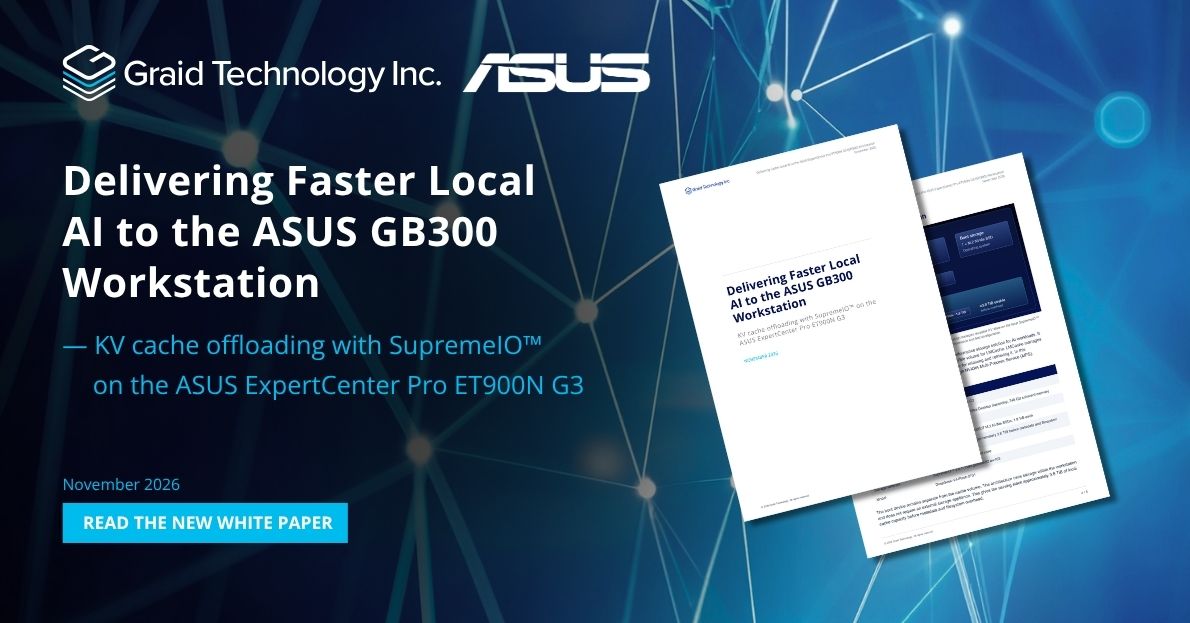
SupremeIO™ delivers 58.6% lower mean TTFT and 40.3% higher completion throughput on the ASUS ExpertCenter Pro ET900N G3 with KV cache offloading. Read our latest white paper to get the benchmark results.

Visit Graid Technology and our partner Beiliande at Smart Campus CIO 2026 Booth 18 in Wuhan, November 19–20, to see SupremeStore high-performance cluster storage for AI and HPC, and software-defined solutions that put your existing GPUs to work. Stop by to see how our solutions work together.
October 15, 2026
Graid Technology Featured in TechArena’s AI Infrastructure Report, The Integrated Machine
Graid Technology is featured in TechArena’s report The Integrated Machine. Field CTO Randy Kreiser discusses KV cache, inference performance, and why storage has to be designed into the rack from the start.