

VROC™ by Graid Technology Inc. (Available Q3 2026)
VROC™ by Graid Technology is the next-generation CPU-native NVMe RAID solution for Intel® Xeon® 6 platforms — delivering bootable RAID 0/1/5/10 directly from the CPU PCIe root complex, no HBA required. Actively developed by Graid Technology, it eliminates the cost, complexity, and power of traditional RAID cards. Support for Intel® VROC under Graid Technology remains available for existing deployments.
VROC™ by Graid Technology Inc. (Available Q3 2026)
VROC™ by Graid Technology is the next-generation CPU-native NVMe RAID solution for Intel® Xeon® 6 platforms — delivering bootable RAID 0/1/5/10 directly from the CPU PCIe root complex, no HBA required. Actively developed by Graid Technology, it eliminates the cost, complexity, and power of traditional RAID cards. Support for Intel® VROC under Graid Technology remains available for existing deployments.
Simple, Powerful Data Protection— Now With An Active Roadmap
Next-Generation CPU-Based NVMe RAID for Intel® Xeon® 6 and Beyond — built to scale with the demands of enterprise, AI, and high-performance computing infrastructure, backed by an active roadmap shaped by Tier 1 OEMs and real customer deployments.
Comprehensive RAID Support: Bootable RAID 0/1/5/10 protection with VMware ESXi RAID 1/5 on the roadmap
Flexible Scalability: Expand across multiple NVMe and SATA drives and RAID arrays with no add-in card
Direct-to-CPU Performance: SSDs connect straight to the CPU PCIe root complex — full PCIe bandwidth, zero HBA tax
Streamlined Architecture: Eliminates the separate RAID card, reducing complexity, power, and BOM cost
Native Platform Integration: NVMe drives appear directly to the platform for first-class management, monitoring, and event handling — no separate HBA toolchain
Efficient & Reliable: Lower power, minimal CPU overhead, simplified system maintenance
SupremeRAID™ Coexistence: Run VROC for boot and database alongside SupremeRAID for GPU-accelerated AI workloads on a single Intel® Xeon® platform
Backed by an Active Roadmap: 24-month roadmap shaped with Tier 1 OEMs — including GPUDirect Storage (GDS), OpenBMC, PLDM5 OOB firmware updates, SED hot-plug, NVMe HDD, and PCIe Gen 6

Built for Modern CPU-Direct NVMe Storage
Modern CPU platforms generate enormous bandwidth, and storage architecture has to match. VROC™ by Graid Technology connects NVMe SSDs directly to the CPU PCIe root complex, delivering full-bandwidth bootable RAID without a hardware HBA in the path. Launching on Intel® Xeon® 6 D and W — including Birch Stream, Granite Rapids WS, and Kaseyville — with an active roadmap that expands platform support as processor generations advance.
Built for Modern CPU-Direct NVMe Storage
Modern CPU platforms generate enormous bandwidth, and storage architecture has to match. VROC™ by Graid Technology connects NVMe SSDs directly to the CPU PCIe root complex, delivering full-bandwidth bootable RAID without a hardware HBA in the path. Launching on Intel® Xeon® 6 D and W — including Birch Stream, Granite Rapids WS, and Kaseyville — with an active roadmap that expands platform support as processor generations advance.
VROC™ by Graid vs. Legacy HBA-Based RAID
45%
31%
49%
75%
Performance Highlights
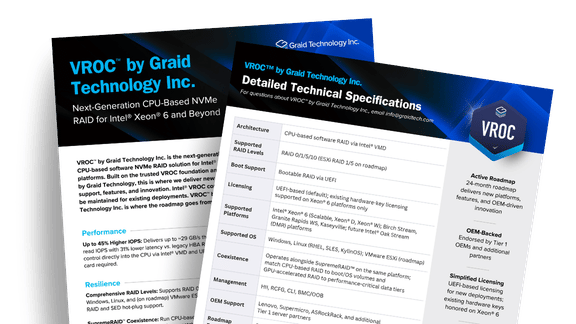
VROC™ by Graid Technology scales with NVMe SSDs to deliver up to ~29 GB/s throughput and ~6M read IOPS — consistently outperforming legacy HBA-based RAID on every dimension that matters: more IOPS, lower latency, lower power draw, and lower total system cost. Read the product brief.
Performance Highlights
VROC™ by Graid Technology scales with NVMe SSDs to deliver up to ~29 GB/s throughput and ~6M read IOPS — consistently outperforming legacy HBA-based RAID on every dimension that matters: more IOPS, lower latency, lower power draw, and lower total system cost. Read the product brief or read the press release.