Contact Us


Article
May 5, 2022
NEWS:✨ Graid Technology SupremeRAID™ SR-1010 Featured By HotHardware
“Absolutely astonishing storage performance. We don’t know exactly what Graid’s algorithm looks like, but whatever magic it’s doing, it seems to work.”
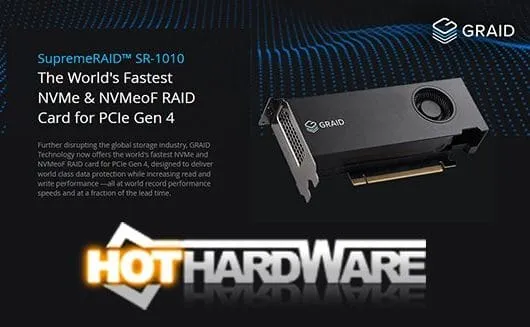
Graid SupremeRAID™ Rocks Ampere GPU, Delivers Screaming-Fast SSD Storage At 110 GB/s
(HotHardware.com, April 28, 2022 [Read It Here] ) -- It wasn’t that long ago that we were all using regular old spinny disks for storage. Time was, you really wanted to use dedicated hardware for RAID arrays to get the best performance. Plugging them into your motherboard and using software—or worse, firmware—RAID was seen as the inferior, poor man’s option. Using a proper RAID card got you access to superior performance as well as improved reliability.
These days, those in the know stick to software RAID, because hardware RAID cards simply don’t cut it with multiple NVMe SSDs. Solutions like ZFS have become popular among the audience that traditionally would have used hardware RAID. Still, managing large arrays using software RAID can put a heavy load on the CPU—so much so that in systems with slower processors, it can become the bottleneck for I/O performance.
Enter Graid Technology. A small startup in Santa Clara, California, Graid wowed storage nerds last year when it released the SupremeRAID™ SR-1000 PCIe card. Graid’s technology is a sort of fusion of software and hardware RAID. Essentially, it works like software RAID, but instead of running on the CPU, it runs on a powerful GeForce GPU on the SupremeRAID™ card.n
Last year’s SupremeRAID™ SR-1000 is based on a lowly NVIDIA T1000 card, and yet it can deliver absolutely astonishing storage performance: over 30 GB/sec in sequential reads and nearly 9 million random read IOPS from a RAID5 array.
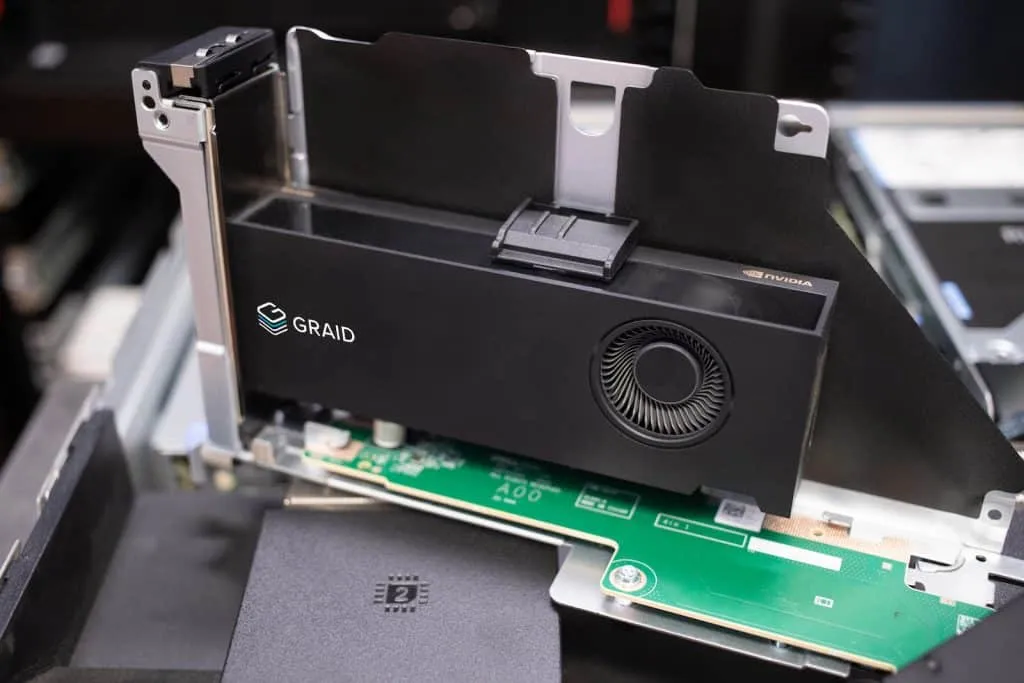
Of course, as with anything in computing, no matter how fast something is, there will be someone who wants it to be even faster. Naturally, that means a new version of the Graid card, known simply as the SupremeRAID™ SR-1010. The latest version leverages a newer NVIDIA A2000 GPU based on the GA106 GPU that powers the GeForce RTX 3060.
It’s easy to forget that GA106 is a monstrously-powerful processor. Sure, it may seem unassuming next to its more-potent GeForce siblings, but we’re still talking about a microprocessor that can perform some 12.7 trillion half-precision floating-point operations per second, and many more if you can make use of the chip’s onboard tensor processors. We don’t know exactly what Graid’s algorithm looks like, because it’s completely proprietary. We do know it leverages AI in some fashion, though, so it’s probably making heavy use of the Ampere GPU’s tensor compute units.
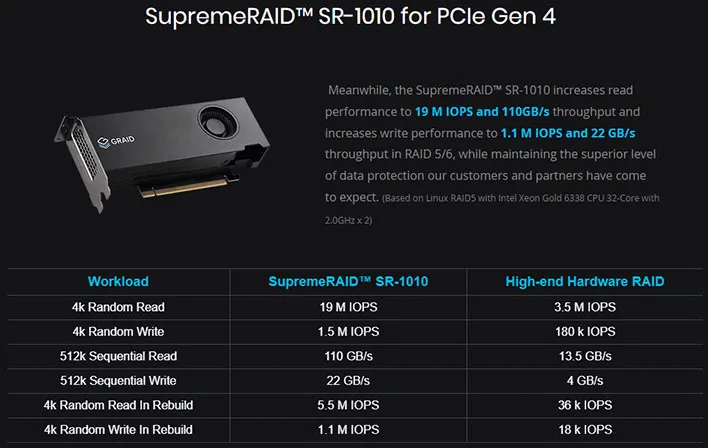
Whatever magic it’s doing, it seems to work. Graid says that the new card can offer read performance up to 110 GB/second in throughput, and up to 19 million IOPS. Write performance is drastically improved, too— Graid says the new card will do up to 1.1M random write IOPS and 22GB/sec write throughput in RAID 5. This performance is possible because the Graid card is just managing the array—none of the stored data actually passes through the PCIe interface to the Graid card itself.
If you’re fascinated by this idea, or an existing Graid fan looking to upgrade, the company says that general availability of the new model will begin on May 1 for folks who place orders beforehand.
News & Resources

Visit Graid Technology at SC26 Booth 1326 in Chicago, November 17–19, to see GPU-accelerated I/O for AI inference and CPU-native data protection with VROC™ by Graid Technology. Stop by to enter our raffle for a pair of Meta glasses.

Storage Review built a shared storage host that gives eight NVIDIA DGX Spark systems access to one parity-protected Solidigm QLC pool, with SupremeRAID™ handling RAID 5 on a GPU. Here is what the testing showed and why it matters for AI labs and enterprise desktop AI fleets.
October 15, 2026
Graid Technology Featured in TechArena’s AI Infrastructure Report, The Integrated Machine
Graid Technology is featured in TechArena’s report The Integrated Machine. Field CTO Randy Kreiser discusses KV cache, inference performance, and why storage has to be designed into the rack from the start.