Contact Us



Article
January 30, 2024
File Storage Technologies: Graid Expands Towards Desktop and Edge Servers
Graid Technology, the leading name in modern RAID controllers, unveils its latest innovation, the SupremeRAID SR-1001, catering to the surging global demand for NVMe SSDs across various storage segments, including primary and secondary storage, servers, and workstations. Boasting superior performance over traditional hardware and software RAID solutions, the SR product line gains widespread support from OS, NVMe SSD, processor vendors, and virtualization players, with versatile configurations for tower, edge servers, and workstations, and potential acquisition interest making it a standout in the storage industry. Read more:
Tuesday, January 30, 2024 | Philippe Nicolas
Graid Technology, the reference in modern RAID controller, recently participated to The IT Press Tour to announce its new board, the SupremeRAID SR-1001. Graid targets the NVMe SSD domain growing as a rapid pace globally in any storage segments , primary and secondary storage but also on servers or workstations direct attached storage. And with this ubiquitous presence of NVMe is transversal to any use cases and verticals.
I already wrote about Graid and mentioned that the firm is in fact a modern Adaptec, the reference in RAID controller many years ago. RAID hardware seems to be limited when used with NVMe devices, RAID software limits CPU usages confirming that GPU embedded on a board is a good approach.
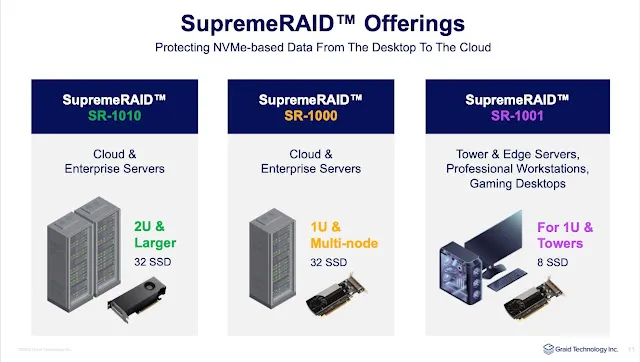
We all know that SR-1000 and SR-1010 are dedicated respectively for cloud and enterprise servers supporting 1U and 2U servers with 32 SSDs each. As said, Graid introduced the SR-1001 for tower, edge servers and workstations for 1U and 8 SSDs max.
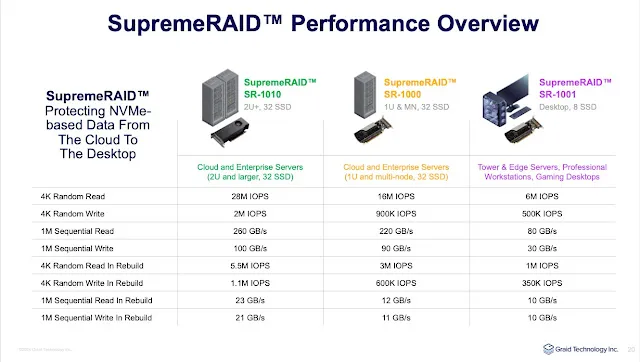
The SR product line beats classic hardware RAID cards and of course software RAID who appears to be a gadget in some cases. Graid has been recognized by OS, NVMe SSD, processor vendors and virtualization players and the list is huge. It's difficult to find a brand not supporting Graid, oh yes, there is one, HPE who always does and makes strange things and decisions in storage. The SR product line is sold by a vast resellers, distributors and oems.
We touched during our last meeting in October 2022 but today active/active and active/passive configurations are possible within the same chassis. Beyond classic implementation with servers,, edge machines and workstations, the SR card can be deployed as a target or initiator on NVMe-oF network.
The team has also reduced the size of the SR-1010 card to physically occupy only 1 slot dimension.
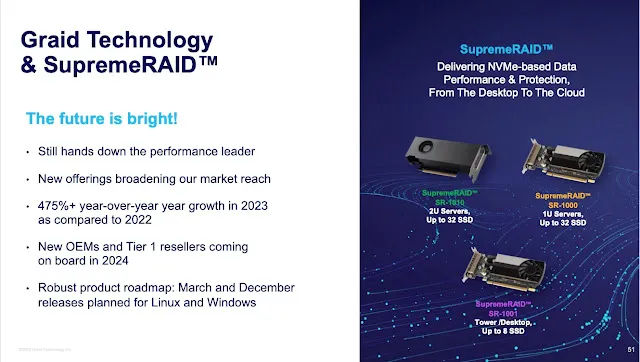
It's not sure Graid will stay independent a long time and we'll have a new opportunity to meet the team again as the company represents a serious target for several vendors with a unique product line. This is great to be so attractive. Good luck
BY PHILIPPE NICOLAS / Read it on FST: File Storage Technologies Blog
News & Resources

Visit Graid Technology at SC26 Booth 1326 in Chicago, November 17–19, to see GPU-accelerated I/O for AI inference and CPU-native data protection with VROC™ by Graid Technology. Stop by to enter our raffle for a pair of Meta glasses.

Storage Review built a shared storage host that gives eight NVIDIA DGX Spark systems access to one parity-protected Solidigm QLC pool, with SupremeRAID™ handling RAID 5 on a GPU. Here is what the testing showed and why it matters for AI labs and enterprise desktop AI fleets.

October 15, 2026
Graid Technology Featured in TechArena’s AI Infrastructure Report, The Integrated Machine
Graid Technology is featured in TechArena’s report The Integrated Machine. Field CTO Randy Kreiser discusses KV cache, inference performance, and why storage has to be designed into the rack from the start.