Contact Us


Article
February 16, 2024
Dutch IT Channel: Graid Technology Optimizes RAID from PC to Cloud with SupremeRAID™
SupremeRAID™, unlike traditional RAID, serves as PCIe-connected co-processors on the host motherboard, eliminating a crucial bottleneck in the data path. It outperforms older RAID cards like Broadcom's 9600 and 9500 systems in absolute terms and demonstrates significant superiority over software RAID solutions that utilize host server CPU cycles for RAID parity calculations.
(Hans Steeman for Dutch IT Channel / Feb. 16, 2024) RAID has been a technology used to protect data on storage media for 50 years. Now that flash is becoming increasingly popular, an improvement is needed to ensure that the performance of RAID does not hinder the use of flash storage technology. Tom Paquette, SVP&GM NA/EMEA/ANZ/India of the Santa Clara-based startup Graid Technology, founded in 2021, explained during the IT Press Tour how Graid Technology solves that dilemma. Graid Technology supplies a RAID card built on an Nvidia GPU that does its work at the edge of the network.
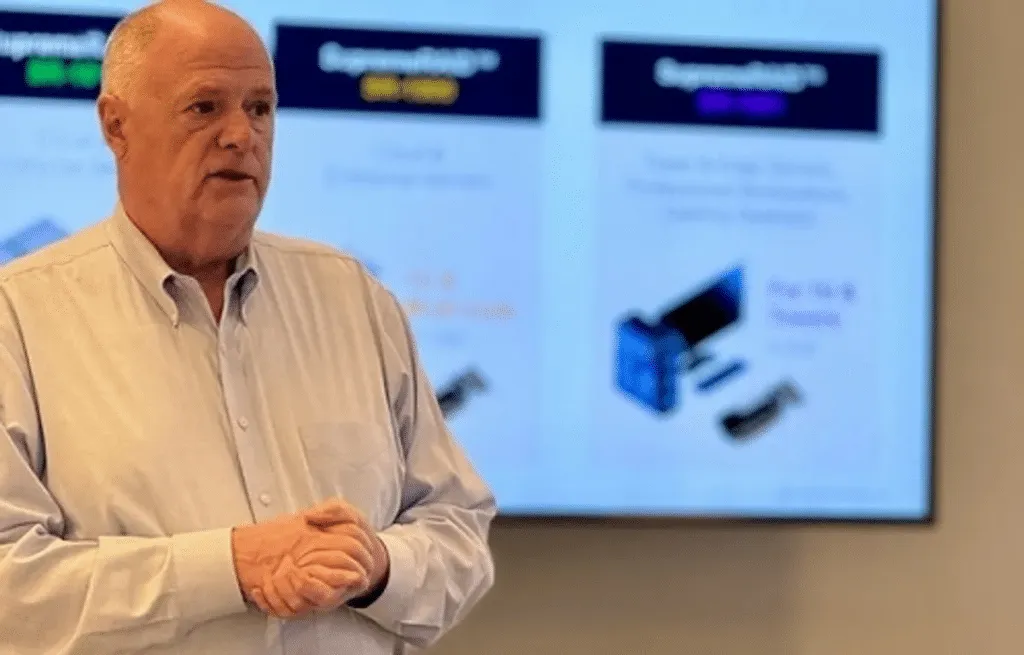
Tom: “Unlike traditional RAID cards that plug directly into storage drives, Graid's SR or SupremeRAID products are PCIe-connected co-processors on the host motherboard and are not in the data path. In doing so, they eliminate an important bottleneck. As NVMe SSDs play a critical role in cloud, core and edge infrastructure, the demand for enhanced data protection without compromising performance is evident. The SupremeRAID SR-1001 addresses this need by achieving best-in-class performance and foolproof data protection, while optimizing throughput, parallelism and latency, ensuring perfect performance at the edge.”
Graid Technology claims that performance is significantly higher in absolute terms compared to older RAID cards, such as Broadcom's 9600 and 9500 systems. This does not alter the fact that the SR-1001 cards perform slightly less in terms of performance than Broadcom's 9600 implementation, but they make up for this with significantly better sequential data throughput.
The SupremeRAID cards are also significantly superior to software RAID products, which use host server CPU cycles for RAID parity calculations and can severely limit the overall performance of server applications.
News & Resources

Visit Graid Technology at SC26 Booth 1326 in Chicago, November 17–19, to see GPU-accelerated I/O for AI inference and CPU-native data protection with VROC™ by Graid Technology. Stop by to enter our raffle for a pair of Meta glasses.

Storage Review built a shared storage host that gives eight NVIDIA DGX Spark systems access to one parity-protected Solidigm QLC pool, with SupremeRAID™ handling RAID 5 on a GPU. Here is what the testing showed and why it matters for AI labs and enterprise desktop AI fleets.
October 15, 2026
Graid Technology Featured in TechArena’s AI Infrastructure Report, The Integrated Machine
Graid Technology is featured in TechArena’s report The Integrated Machine. Field CTO Randy Kreiser discusses KV cache, inference performance, and why storage has to be designed into the rack from the start.