Contact Us


Blog
October 9, 2023
Blog: Top Five Challenges Posed by Traditional RAID, and How They Can Be Solved
Traditional hardware- and software-based RAID poses many technical and performance issues that hinder the capabilities of NVMe SSDs, which, in turn, limits the ability of computing systems to quickly store and retrieve large amounts of critical data. Trenton Systems and Graid Technology Inc. have partnered to create a fully integrated, end-to-end solution that unlocks the full potential of NVMe SSDs to maximize performance on-premises and at the edge. [Trenton Systems Blog, Oct 5, 2023]
What is RAID (Redundant Array of Independent Disks)?
RAID, which stands for Redundant Array of Independent Disks is a technology used in data storage to improve performance, reliability, and/or both.
It involves using multiple physical hard drives (or SSDs) together in various configurations to achieve specific goals, such as redundancy, increased speed, or a combination of both.
The choice of RAID level depends on the specific needs of the storage system, such as performance, data protection, and available hardware. RAID arrays are commonly used in enterprise environments to ensure data availability and reliability, but they can also be employed in consumer-grade storage solutions for improved performance and data security.
What are the top five challenges posed by traditional RAID?
Hardware-based RAID
Hardware-based RAID (Redundant Array of Independent Disks) systems have been widely used for data storage and redundancy. However, they come with several challenges, including:
- Cost: Hardware-based RAID solutions typically involve specialized RAID controllers, which can be expensive. These controllers are often proprietary and require additional hardware components, contributing to higher overall system costs.
- Scalability: Expanding a hardware-based RAID array can be challenging. Adding more disks often means purchasing additional RAID controllers and potentially even migrating data to a new RAID level or configuration. This scalability limitation can be a significant hindrance in dynamic environments where storage needs can quickly change.
- Performance Bottlenecks:
- CPU Utilization: Hardware-based RAID controllers offload many of the complex RAID calculations (e.g., parity calculations in RAID 5 and RAID 6) onto the system's CPU. While modern CPUs are powerful and capable, these calculations can still consume a substantial portion of CPU resources, especially when handling a high volume of I/O operations. This CPU utilization can limit the overall system performance, particularly in scenarios with heavy disk activity.
- I/O Bottlenecks: Hardware-based RAID controllers can become performance bottlenecks, especially when handling high I/O workloads. All data traffic must pass through the controller, which can lead to contention and reduced performance. Even the fastest hardware RAID products cannot match the aggregate performance of solid-state drives (SSDs). The resulting performance bottleneck is unavoidable and worsens when using SSDs with PCI Express (PCIe) and NVM Express (NVMe) technologies.
- Write Penalty: Many RAID configurations, such as RAID 5 and RAID 6, suffer from a “write penalty” because they require multiple disk operations to write data. This can significantly impact write-intensive workloads.
- Rebuild Times: When a disk in a RAID array fails, the process of rebuilding data onto a replacement disk can take a long time. During this rebuild process, the system’s performance may be degraded, and there is an increased risk of another disk failure (resulting in data loss for some RAID levels).
- Complexity: Setting up and managing traditional hardware-based RAID can be complex. Configuration options, such as choosing the right RAID level, stripe size, and hot spare policies, require expertise. RAID management interfaces are often vendor-specific and may not be intuitive for all administrators.
- Vendor Lock-In: Hardware-based RAID solutions are often tied to specific vendors and hardware platforms. This can create vendor lock-in, making it difficult and costly to switch to a different storage solution or migrate data to a different platform in the future.
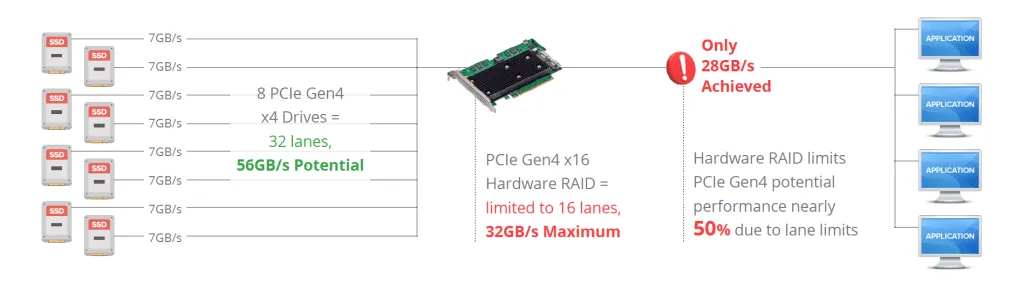
Even the fastest hardware RAID products cannot match the aggregate performance of solid-state drives (SSDs). The resulting performance bottleneck is unavoidable and worsens when using SSDs with PCI Express (PCIe) and NVM Express (NVMe) technologies.
Software-based RAID
Software-based RAID offers a cost-effective way to achieve data redundancy and performance improvements using standard hardware. However, it also comes with its own set of challenges and limitations, including:
- Performance Overhead: Software-based RAID relies on the host CPU to manage the RAID array. This can result in a significant performance overhead, especially for complex RAID levels like RAID 5 and RAID 6. The CPU has to handle data striping, parity calculations, and other RAID functions, which can impact the overall system performance.
- Limited RAID Levels: Software-based RAID typically supports a limited set of RAID levels compared to hardware RAID controllers. It may not offer advanced RAID levels like RAID 10 or RAID 50, limiting the flexibility and performance optimization options available.
- Scalability: Expanding or reconfiguring a software-based RAID array can be more challenging than with hardware-based RAID. Adding new drives or changing the RAID level often requires migrating data and can be error-prone, potentially leading to data loss.
- Dependency on the Operating System: Software-based RAID is closely tied to the operating system. If the OS experiences issues or becomes corrupted, it can affect the integrity of the RAID array. Additionally, software RAID may not be available or fully functional on all operating systems.
- Limited Performance in High-Load Environments: In high-demand environments with heavy I/O loads, software-based RAID can struggle to keep up with the demand. Hardware-based RAID controllers often have dedicated processors and cache memory to handle such loads more efficiently.
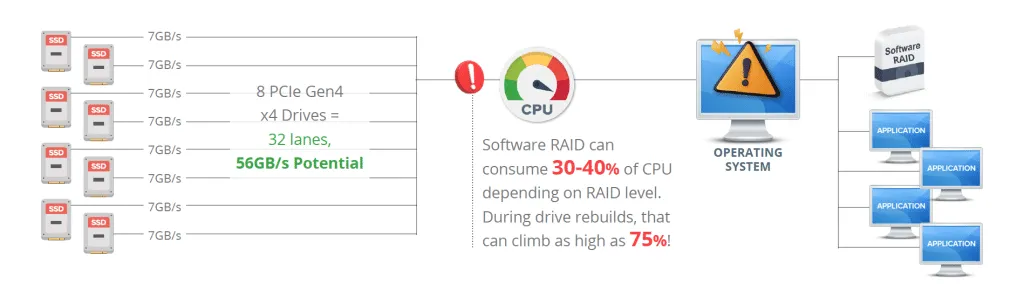
Software-based RAID relies on the host CPU to manage the RAID array, resulting in significant performance overhead, especially for complex RAID levels like RAID 5 and RAID 6, which can impact the overall system performance.
It is important to note that software-based RAID can be a viable solution for certain scenarios, especially when cost savings are a priority or when using a RAID configuration for non-mission-critical applications.
However, for high-performance and mission-critical applications, hardware-based RAID controllers or even hybrid solutions may be a better choice to address these challenges effectively.
How can these problems be fixed?
To address some of these challenges, many organizations have started to explore GPU-based software RAID solutions or software-defined storage (SDS) options. These approaches can provide greater flexibility, scalability, and cost-effectiveness while mitigating some of the performance bottlenecks associated with traditional hardware-based RAID.
Additionally, advancements in hardware technology, such as faster storage interfaces (e.g., NVMe) and more powerful CPUs, have allowed for better RAID performance in modern systems.
Introducing SupremeRAIDTM
Graid Technology Inc.’s SupremeRAIDTM is a software-defined RAID solution deployed on a GPU to maximize NVMe SSD performance without overloading a CPU.
Unlike traditional hardware- and software-based RAID, data travels directly from the CPU to storage, minimizing performance bottlenecks while increasing scalability, improving flexibility, and reducing total cost of ownership.
It combines two powerful technologies — software-defined storage and GPU acceleration — to create an innovative solution ideal for NVMe SSD data protection. The result is better RAID-protected storage with the same PCIe NVMe SSDs.
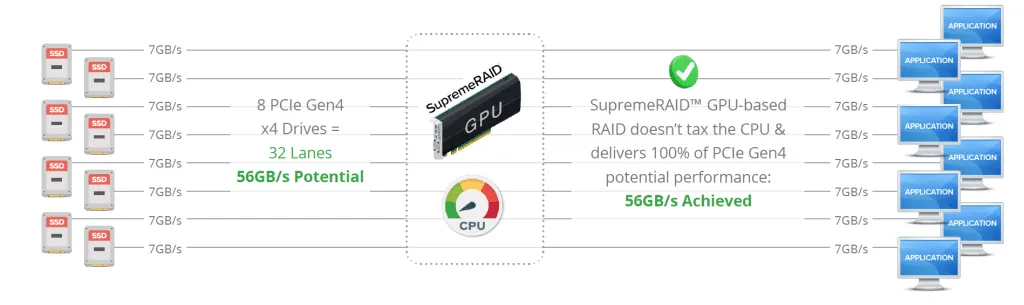
taxing the CPU, to deliver the full potential of your SSD performance
SupremeRAID™ combines two powerful technologies — software-defined storage and GPU acceleration — to create an innovative solution ideal for NVMe SSD data protection. The result is better RAID-protected storage with the same PCIe NVMe SSDs.
SupremeRAID™ Value vs. Traditional RAID
Instant Return on Investment: SupremeRAID™ exceeds performance requirements with fewer SSDs. The amount of money saved more than pays for the SupremeRAID™ solution.
Non-blocking Performance: SupremeRAID™ leaves SSDs connected to the server board, eliminating the unavoidable bottlenecks that exist when SSDs connect to add-in cards.
Higher System Efficiency: SupremeRAID™ needs minimal resources to protect data, leaving more CPU cores for applications and more PCIe bandwidth for data.
Better Storage Availability: SupremeRAID™ performance remains little changed during SSD failures, protecting service levels for databases, applications, and users.
Faster RAID Recovery: SupremeRAID™ rebuilds data at multiple TBs per hour with a low impact on performance, enabling recovery to begin anytime and complete quickly.
Fast and Easy Installation: SupremeRAID™ installation couldn’t be easier. Just plug it in and go. Competitors’ hardware RAID product installs can require reconfiguring drive bays, replacing drive cables, and changing power connections.
Future-proof Solution: SupremeRAID™ supports PCI Gen 3, 4, and 5 servers and SSDs with one solution. Hardware RAID competitors replaced old Gen 3 products with new Gen 4 ones, but none of their products are available with Gen 5 support.
How SupremeRAID™ Wins Over Traditional RAID
FeaturesBenefitsAdvantagesRecord-setting RAID storage performanceScale up to 28M IOPS and 260GB/s throughputUse more of your SSD’s performance while protecting dataModern software-defined storageRelies on flexible software to deliver functionalityAdds and improves features with every software releaseGPU add-in card for RAID accelerationOffloads RAID computations from the system’s CPUFrees-up CPU cores to process database and app workloadsPCIe Gen 3, 4, and 5 support todayBackward and forward SSD and system compatibilitySupports future tech refreshes using the same RAID solutionConnect SSDs using NVMe and NVMeoFUse internal and external direct-attached SSDsExpands storage beyond the limits of server SSD baysScale RAID storage from 2 to 32 SSDsConsolidate system data protection using one RAID solutionAvoids having to use two or more of the same RAID solutionNo battery backups modulesHigh performance without volatile caching & batteriesNo battery backup modules to purchase, monitor and replaceSame solution for Linux and WindowsStandardize on one RAID solution across multiple data centersSimplify system design, management, and administration
Where does Trenton Systems come into play?
Trenton Systems provides cybersecure, USA-made, COTS hardware with the latest high-performance computing technologies—including next-gen PCIe, CPUs, GPUs, and NVMe SSDs —that can unleash the full potential of SupremeRAIDTM to quicky process, analyze, store, retrieve, and transfer large amounts of critical intelligence in seconds.
In partnership with Graid Technology Inc., we deliver end-to-end, turnkey solutions with all necessary hardware and software fully integrated before ever reaching a customer and/or end user, thus enhancing out-of-box experience.
This, in turn, equips defense and enterprise personnel with readily-deployable systems for a wide range of applications and services.
We work with customers in a consultative relationship to craft systems and solutions per their most complex technical, performance, and environmental requirements.
Final thoughts
RAID technology plays a crucial role in data storage, offering a variety of configurations to meet specific needs. Traditional hardware-based RAID and software-based RAID both have their challenges, including cost, scalability, performance bottlenecks, complexity, and vendor lock-in.
To address these issues, organizations are exploring GPU-based software RAID and software-defined storage options, taking advantage of advancements in hardware technology.
One innovative solution in this space is SupremeRAID™ by Graid Technology Inc. This software-defined RAID solution deployed on a GPU maximizes NVMe SSD performance while minimizing CPU overload, offering benefits such as instant return on investment, non-blocking performance, higher system efficiency, and faster RAID recovery. It is a future-proof solution that supports a wide range of SSDs and server generations.
Trenton Systems, in partnership with Graid Technology Inc., provides the hardware necessary to fully harness the potential of SupremeRAID™. Their cybersecure, USA-made COTS hardware, equipped with the latest high-performance computing technologies, ensures that SupremeRAID™ can process, store, and retrieve critical data rapidly. Together, this offers end-to-end, turnkey solutions to ensure rapid deployment for defense and enterprise applications.
As technology continues to evolve, solutions like SupremeRAID™ and the support provided by Trenton Systems offer a path toward more efficient and flexible data storage and protection, meeting the demands of modern computing environments.
Embracing these innovations can lead to improved data management and storage capabilities for various industries, paving the way for more resilient and high-performance systems in the ever-evolving world of technology.
About Trenton Systems
Trenton Systems is a trusted computing innovator providing cybersecure, tactical edge computing solutions to the defense and aerospace industries. Established in 1989 and headquartered in Atlanta, Georgia, the company is a pioneer of made-in-USA computing solutions and has endured firmly and unwaveringly at the forefront of the high-performance computing industry for more than 30 years, designing, manufacturing, assembling, testing, and supporting customer-driven rugged computers that accelerate and underpin the world’s mission-critical programs, applications, and critical infrastructure processes. Learn more at trentonsystems.com
About Graid Technology
Graid Technology Inc. is redefining performance standards for high-performance data protection. Headquartered in Silicon Valley, California with an R&D center in Taipei, Taiwan, our leadership is composed of a dedicated team of experts with decades of experience in the SDS, ASIC, and storage industries. Chosen by CRN as one of the Ten Hottest Data Storage Startups of 2021 and a 2022 Emerging Vendor in the Storage & Disaster Recovery category, Graid Technology Inc. has developed the world's only NVMe and NVMeoF RAID card to unlock the full potential of PCIe 3, 4, and 5 SSD performance: a single SupremeRAID™ card blasts performance to 28 million IOPS and 160GB/s of throughput. For more information visit graidtech.com
News & Resources

Visit Graid Technology at SC26 Booth 1326 in Chicago, November 17–19, to see GPU-accelerated I/O for AI inference and CPU-native data protection with VROC™ by Graid Technology. Stop by to enter our raffle for a pair of Meta glasses.

Storage Review built a shared storage host that gives eight NVIDIA DGX Spark systems access to one parity-protected Solidigm QLC pool, with SupremeRAID™ handling RAID 5 on a GPU. Here is what the testing showed and why it matters for AI labs and enterprise desktop AI fleets.
October 15, 2026
Graid Technology Featured in TechArena’s AI Infrastructure Report, The Integrated Machine
Graid Technology is featured in TechArena’s report The Integrated Machine. Field CTO Randy Kreiser discusses KV cache, inference performance, and why storage has to be designed into the rack from the start.