Contact Us


Case Study
June 24, 2026
In the Lab: Graid Technology SupremeRAID™ on Corespan's Photonic PCIe Fabric
SupremeRAID™ on Photonic PCIe: Independent Lab Validation from Corespan Systems
Published June 15, 2026 | Originally authored by Bill Koss, CEO & President, Corespan Systems
Corespan Systems recently published independent lab results validating SupremeRAID™ running GPU-accelerated RAID 6 over their photonic PCIe disaggregation fabric. The test was designed to determine whether a photonic PCIe transport could carry SupremeRAID™'s out-of-path parity architecture without altering the behavior of any software component above it.
"If a photonic PCIe fabric can carry Graid without altering the behavior of one byte above it, it can carry anything you intend to deploy on top of it. That is the thesis. Here is the evidence."
— Bill Koss, CEO & President, Corespan Systems
SupremeRAID™'s out-of-path architecture offloads RAID parity computation to a dedicated NVIDIA GPU while keeping the data plane on PCIe. This design requires the underlying transport to be clean, low-jitter, and behaviorally identical to local silicon. According to Corespan, this made SupremeRAID™ a demanding test of fabric transparency.
Test Configuration
Corespan built the test on production-representative hardware:
- Host: Dual-socket AMD EPYC 9654 (192 cores / 384 threads), Ubuntu 5.15 kernel, iommu=pt, pcie_aspm=off
- Parity engine: NVIDIA A10 GPU (Gen4 x16) running SupremeRAID™
- Storage: Four Kingston SEDC3000ME7T6 7.0 TiB self-encrypting NVMe SSDs, HighPoint Gen5 controller
- Array: RAID 6, 14 TiB usable, all four drives ONLINE at 0% wearout
- Transport: Corespan photonic PCIe-over-optics fabric between host and drive shelf
- Harness: Reproducible validation suite (version 2026-06-15.2), single-command execution, FIO JSON output
Results
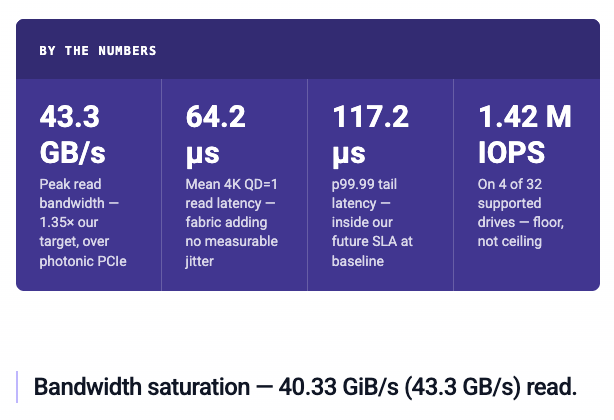
43.3 GB/s peak read bandwidth. 1.35× Corespan's 32 GB/s target. Corespan attributes the result to SupremeRAID™'s out-of-path architecture, which keeps the data plane off the GPU's Gen4 x16 bus.
64.2 µs mean read latency / 117.2 µs p99.99 tail latency. 4K random reads at queue depth 1. Corespan's capability matrix targets sub-150 µs p99.99 under concurrent read/write stress; baseline results came in below that threshold.
1.42 million IOPS. Four drives out of a supported maximum of 32 per NVIDIA A10. Per-drive throughput of approximately 355,000 read IOPS. Corespan notes that at this per-drive scaling rate, a fully populated configuration would exceed their 6 million IOPS target. Two additional performance levers — SPDK mode and NUMA pinning — were not active in this run.
Zero PCIe errors. No DMAR translation errors, no PCIe Advanced Error Reporting faults after sustained mixed workload.
A10 GPU telemetry. Average power draw 60.5 W (150 W cap), SM utilization reaching 100% during parity-heavy phases.
Why This Matters for SupremeRAID™ Deployments
SupremeRAID™'s value proposition depends on the integrity of the PCIe data path. CPU-based RAID burns 3.5 to 5% of host CPU per GB/s of write bandwidth. SupremeRAID™ in SPDK mode targets below 0.2% — roughly a 20× reduction. In a 192-core EPYC host, those are cores returned to your actual workload: inference, training, trading algorithms, risk models.
Corespan's photonic fabric extends that benefit architecturally. Storage no longer has to live in the same chassis as the compute it serves. Drive shelves can be added without forklift upgrades. GPU pools can be remapped dynamically. Corespan's testing confirmed that photonic PCIe disaggregation does not compromise SupremeRAID™'s performance profile — it extends its reach.
What Corespan Is Testing Next
Corespan's validation roadmap includes SPDK-mode CPU cost benchmarks expected to validate the kernel-vs-SPDK delta at roughly 20× lower CPU overhead, online drive failure and rebuild-under-load tests, cryptographic erase timing for SED key rotation, and a fully populated drive run targeting 6 million IOPS with NUMA-pinned affinity.
Read the Full Lab Report
Corespan published the complete field note — including raw FIO methodology, harness details, and A10 telemetry — on their blog.
Read the full Corespan lab report →
Ready to Deploy SupremeRAID™ in Your Infrastructure?
Whether you're designing AI training clusters, HFT platforms, or regulated enterprise storage environments, SupremeRAID™ delivers GPU-accelerated RAID performance that scales with your hardware — and, as Corespan's testing confirms, over transport architectures that go well beyond local PCIe.
Talk to our sales team about what SupremeRAID™ can do for your environment. Use the form below to contact us today.
News & Resources

Visit Graid Technology at SC26 Booth 1326 in Chicago, November 17–19, to see GPU-accelerated I/O for AI inference and CPU-native data protection with VROC™ by Graid Technology. Stop by to enter our raffle for a pair of Meta glasses.

Storage Review built a shared storage host that gives eight NVIDIA DGX Spark systems access to one parity-protected Solidigm QLC pool, with SupremeRAID™ handling RAID 5 on a GPU. Here is what the testing showed and why it matters for AI labs and enterprise desktop AI fleets.

October 15, 2026
Graid Technology Featured in TechArena’s AI Infrastructure Report, The Integrated Machine
Graid Technology is featured in TechArena’s report The Integrated Machine. Field CTO Randy Kreiser discusses KV cache, inference performance, and why storage has to be designed into the rack from the start.