Contact Us


Blog
July 14, 2026
Blog: Stop Paying the Storage Tax
Why Your NVMe Array Is Quietly Underperforming — and What to Do About It
By Garrett McKibben, Senior Director of Technical Marketing, Graid Technology · ~5 min read
_____________________________________________
There's a line item buried in every modern storage stack that almost nobody puts on the budget. Call it the storage tax: the silent percentage of your NVMe investment that disappears into I/O overhead, controller bottlenecks, and CPU cycles you thought you were buying for applications. Until now, you've paid for line-rate flash, gotten a fraction of it, and shrugged off the tax as the cost of doing business. Not anymore. With drive prices through the roof and no end in sight, the tax you used to absorb is the tax you can no longer afford, and the architecture you trusted to prevent exactly this outcome is the one collecting it.
When Hardware RAID Was the Right Answer
For two decades, hardware RAID controllers offered a clean trade. You handed them a pile of disks and they gave back two things: a redundancy layer that survived drive failures, and a guarantee that the CPU wouldn't pay for parity. The ASIC on the card did the XOR math. Your application cores stayed application cores. That bargain held when drives topped out at a few hundred MB/s and a few thousand IOPS. The controller's silicon was faster than the media behind it, so the controller was never the ceiling.
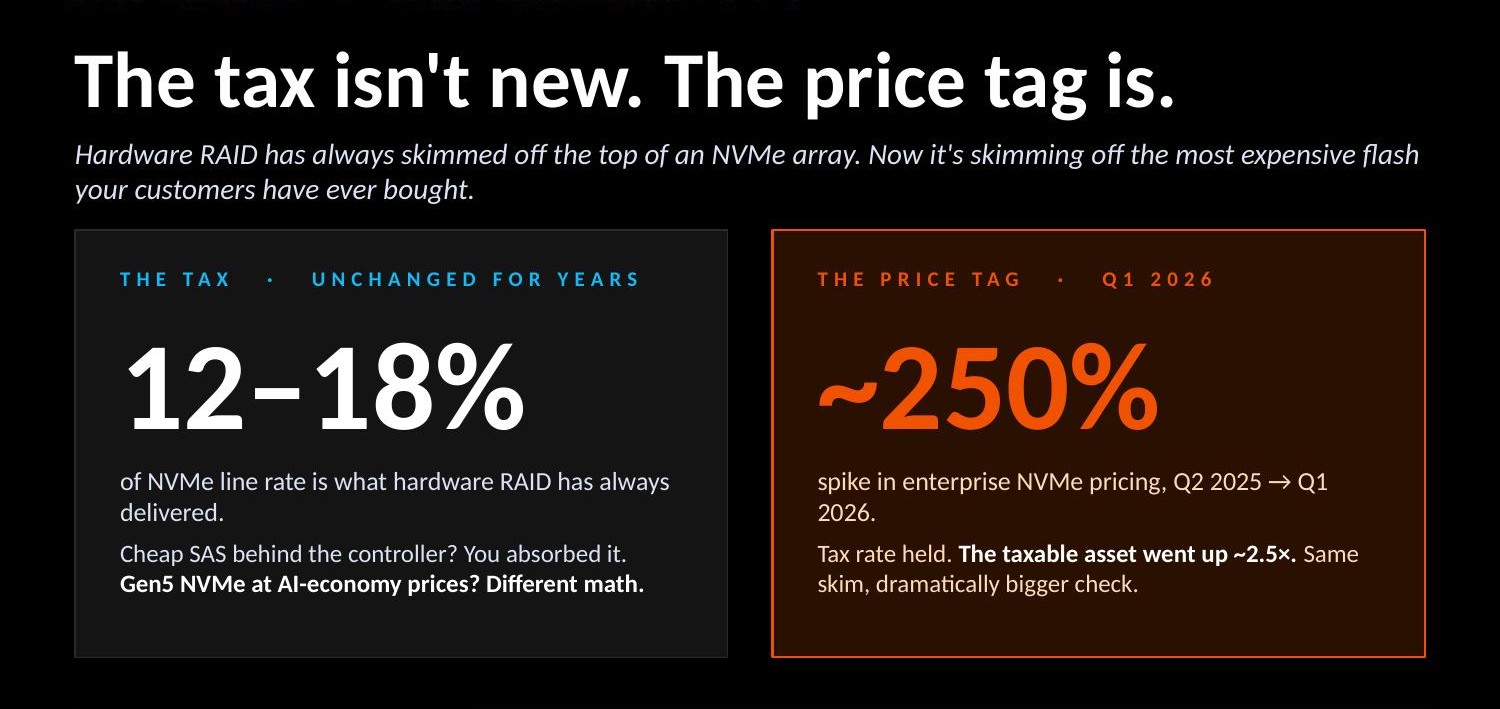
NVMe changed that equation, and it changed it harder than most procurement teams have acknowledged. A single Gen4 NVMe drive does 7 GB/s and a million-plus IOPS. Put twenty-four of them in a chassis and the raw media is doing 150+ GB/s. No conventional ROC ASIC in production today processes parity at that line rate. The math on the card was built for a different decade. So when you bolt an HBA-class hardware RAID controller in front of an NVMe array, the controller becomes the bottleneck. You wired a four-lane highway into a one-lane bridge.
Throughput Tax and CPU Tax
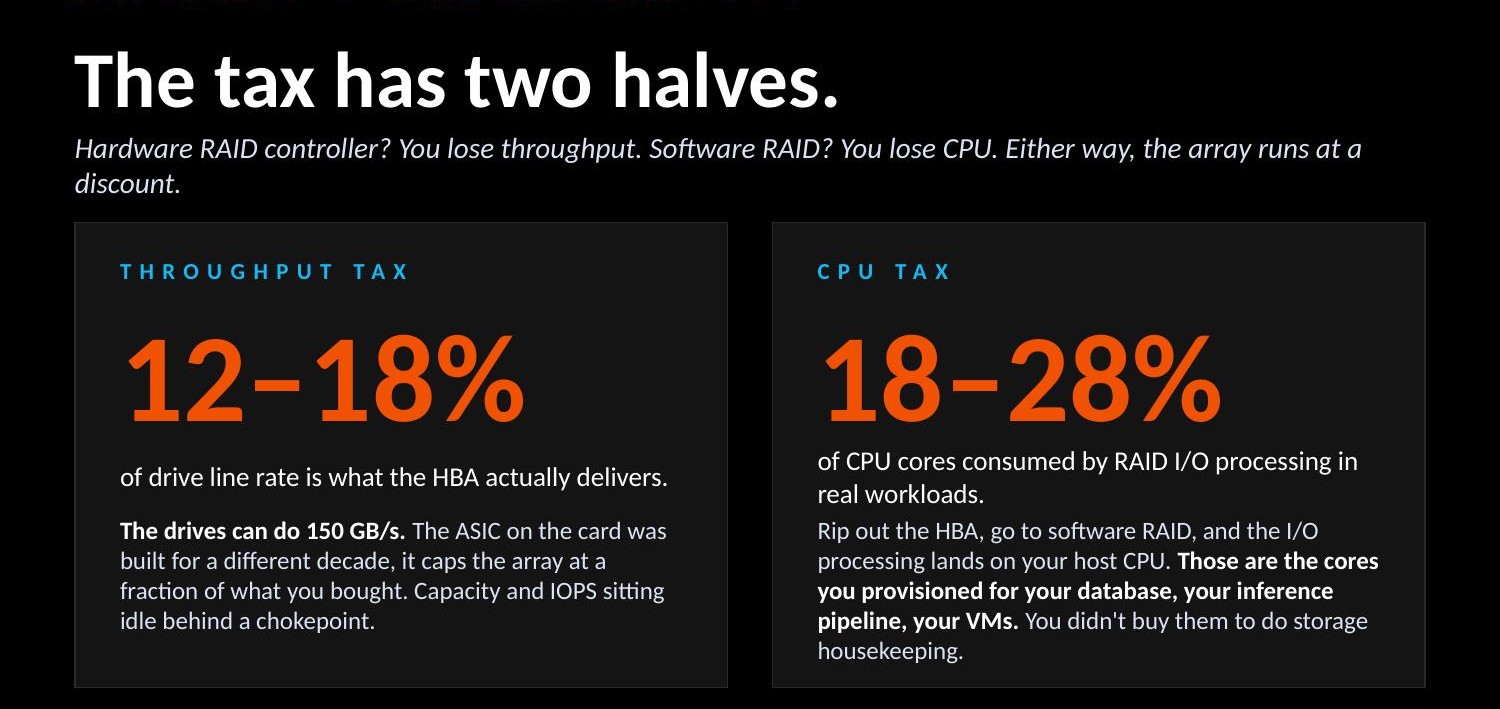
That's the throughput half of the storage tax: the drives can do 150 GB/s but the controller caps the array at twelve to eighteen percent of that. Capacity you bought, IOPS you bought, sitting idle behind a chokepoint.
The CPU half shows up the moment somebody tries to fix the throughput problem by ripping out the hardware controller and going to software RAID, or by adopting an offload card that hands parity to dedicated silicon but still runs its I/O stack on the host. The parity math isn't the culprit — a modern core does XOR at tens of GB/s. The real cost is I/O processing at NVMe scale. A single 4K RAID5 write turns into two reads and two writes; four physical I/Os for one logical write; and at millions of IOPS that read-modify-write amplification buries your cores under interrupts, completions, and queue management. We've measured eighteen to twenty-eight percent of an EPYC's cores consumed by software-RAID I/O processing in real customer workloads. Those are the same cores you provisioned for your database, your inference pipeline, your VMs. You didn't buy them to do storage housekeeping.
So you end up with a choice that isn't really a choice. Hardware RAID controller? You lose throughput. Software RAID or a host-taxing offload card? You lose CPU. Either way the array runs at a discount to what the drives are physically capable of, and the discount is the tax. And acceleration by itself doesn't settle it: the question isn't whether a RAID card accelerates, it's whether that acceleration hands the CPU back to your workload under pressure.
Limited-time offer — Summer 6 Pack: six SupremeRAID™ licenses for the price of five. Available June 15 – September 30, 2026. See the offer →
The Compounding Bill
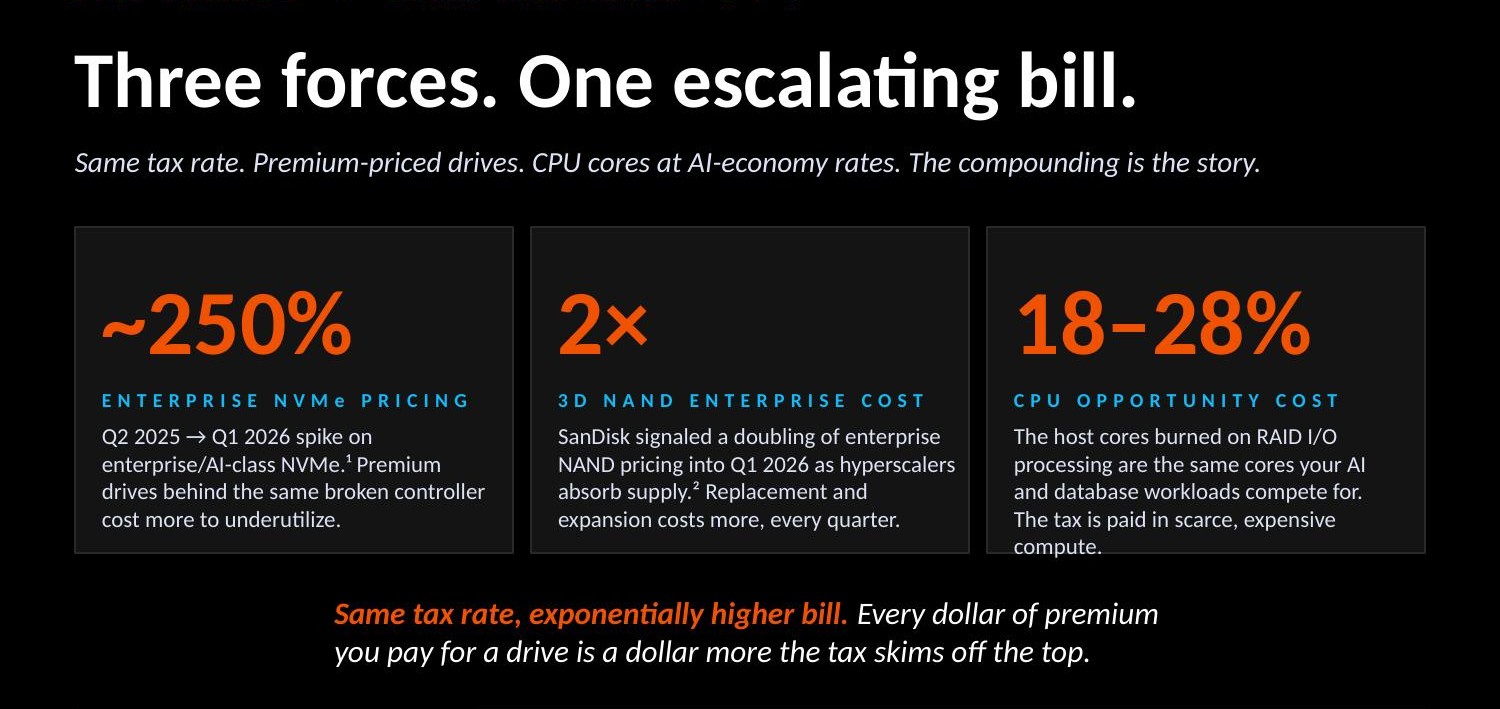
Right now, that arithmetic is compounding. Enterprise NVMe pricing has gone vertical over the past year — VDURA data cited in Tom's Hardware shows 30TB TLC enterprise drives up roughly 257% from Q2 2025 to Q1 2026 (revised upward to 472% in VDURA's April 2026 update), with most large-capacity enterprise SSDs effectively doubling as AI data-center demand and hyperscaler flash contracts absorb available supply. SanDisk, meanwhile, signaled a doubling of enterprise NAND pricing into Q1 2026. The controller bottleneck didn't change. But every drive it taxes is now premium-priced, every drive you buy to compensate is scarcer and pricier, and every CPU core it burns is a core you could've rented to AI workloads at historic rates. Same tax rate, exponentially higher bill.
A 24-drive NVMe array running at twelve to eighteen percent of line rate is a six-figure capital decision underperforming by an order of magnitude. The drives aren't broken. The fabric isn't broken. The bottleneck is the controller you wired in front of them, and the second-order cost — the CPU cycles you have to spend if you remove that controller — is often invisible until your application team complains that latency spiked the day you "improved" storage. The tax compounds: degraded rebuild windows, throttled AI training jobs, sub-line-rate IOPS for OLTP, I/O processing forcing you to overprovision compute to compensate for storage overhead. Every one of those is a downstream invoice for the same upstream problem.
The storage tax just got more expensive. The fix just got cheaper.
A Third Path: GPU-Accelerated RAID
The reason this tax exists is that the industry kept trying to solve a new-media problem with old-media architectures: either a hardware controller whose ASIC can't keep up with NVMe, or host-CPU software RAID that scales with the drives but eats the cores you provisioned for applications. SupremeRAID™ is the third path: software RAID that scales at NVMe line rate, with the RAID I/O workload running on an NVIDIA GPU instead of host CPU cores. The GPU's thousands of cores absorb that I/O processing in parallel — the interrupts, completions, and read-modify-write coordination that millions of IOPS generate — returning the 18–28% of host CPU you were burning on storage housekeeping back to the applications that actually pay for it, and keeping the array at full drive bandwidth instead of HBA bandwidth. Software RAID without the CPU tax. One card. Enterprise-grade protection. No tax.
Conventional wisdom says you pick one: line-rate throughput, free CPU, or hardware RAID; never all three. The storage tax is what you pay for believing that. SupremeRAID™ says you pick all three. The right time to stop paying is the next time you size an NVMe array. Put a SupremeRAID™ card in front of those drives and finally get all the line-rate flash you've been paying for. Without the tax.
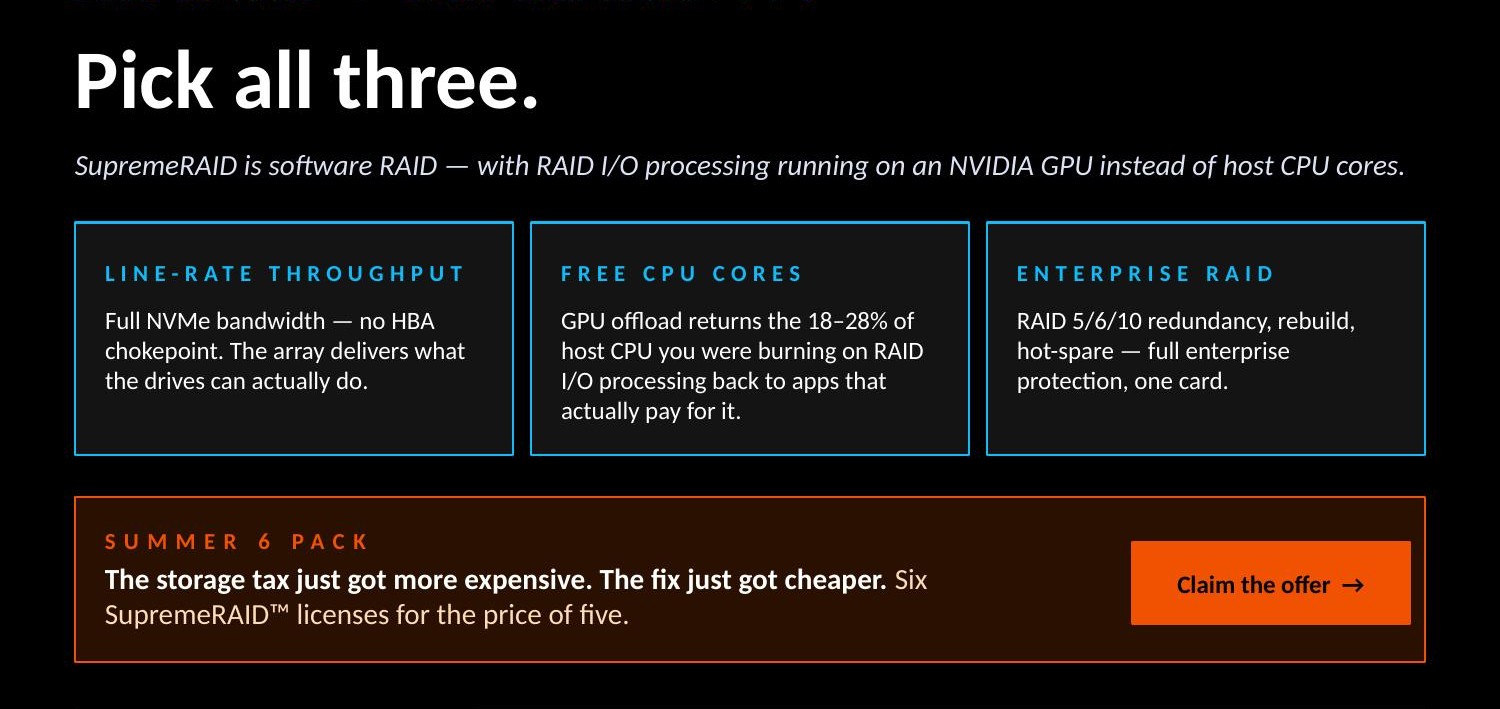
Summer 6 Pack: Six SupremeRAID™ Licenses for the Price of Five
The storage tax just got more expensive. The fix just got cheaper. From June 15 through September 30, 2026, buy five SupremeRAID™ licenses and get the sixth free — discount applied at quote, no rebate, no claim form. Bring your own NVIDIA GPU and use SupremeRAID™ AE, or bundle the license with a GPU sized to your workload (Core, Pro, or Ultra). Either path, same 6-for-5 deal.
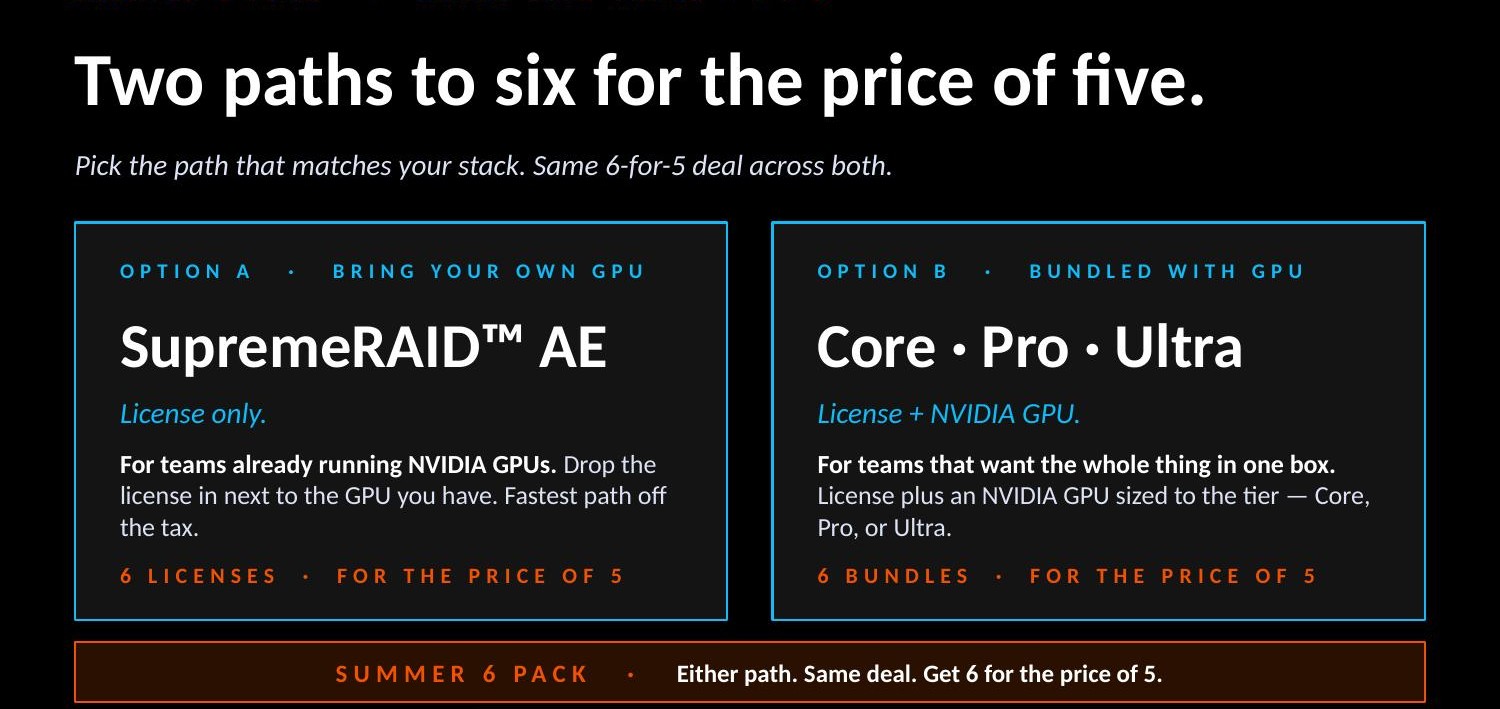
Ready to stop paying? Talk to a Graid Technology rep to lock in the Summer 6 Pack discount before September 30, 2026. Crack Open the Promo →

__________________________
For deeper context
- The end of predictable storage economics and what it means for infrastructure planning — CIO
- AI data centers are swallowing the world's memory and storage supply — Tom's Hardware
- Enterprise SSD prices and shipments surge — industry revenue climbs 28% — TrendForce
News & Resources
.jpg)
Join Graid Technology at OEC booth A7-5 during Japan IT Week Autumn 2026, October 21–23, to explore SupremeRAID™ AE with OEC’s server solutions and SupremeStore for high-performance AI and HPC storage.

Defense systems at the rugged edge need compact servers that can protect and process mission data in extreme conditions. See how Trenton Systems uses VROC™ by Graid Technology and SupremeRAID™ in its U.S.-built TRS14-18.5 1U server to combine resilient boot storage with GPU-accelerated data protection.
.jpg)
Graid Technology will showcase SupremeRAID™ AE and Supreme JBOF at Cypher 2026 in Bengaluru, October 7–9. Explore GPU-accelerated NVMe storage and protected KV cache offloading for AI workloads from server to edge.