Contact Us


News/PR
October 21, 2021
NEWS: ⏩ GIGABYTE Announces a Unique Server Solution to RAID Drawbacks with Graid Technology SupremeRAID™
“GIGABYTE Technology, (TWSE: 2376), an industry leader in high-performance servers and workstations, today announced a new server, GIGABYTE R282-Z9G, that gets around hardware and software RAID limitations that bottleneck RAID when used with NVMe SSDs by incorporating the Graid SupremeRAID™ solution into the R282-Z9G.”
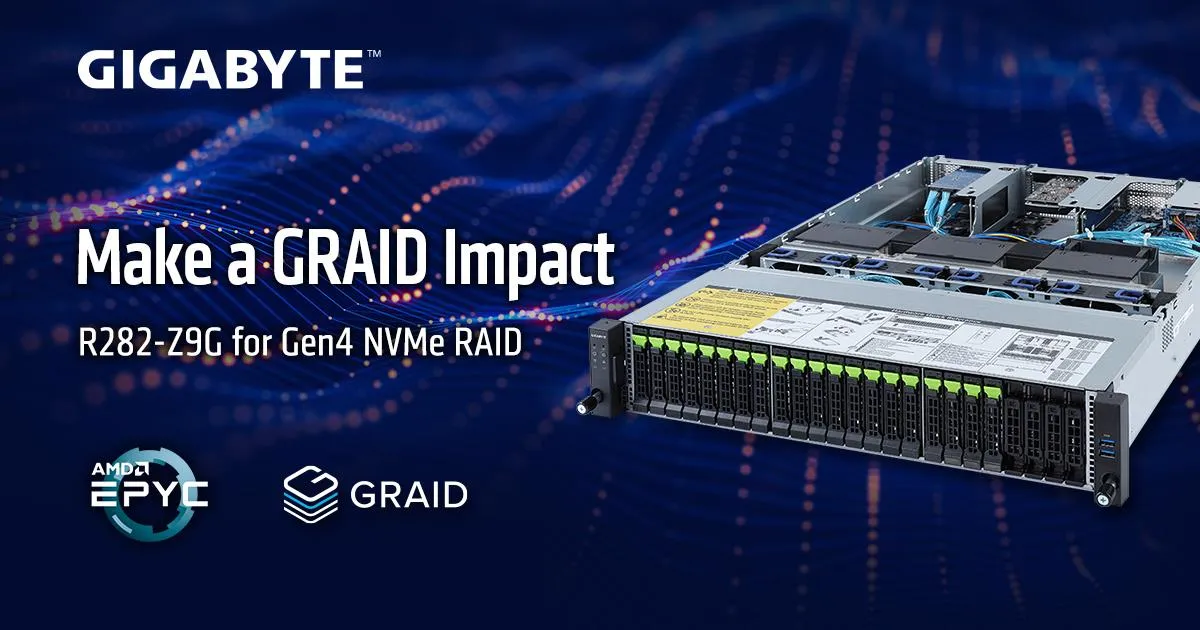
GIGABYTE Technology, (TWSE: 2376), an industry leader in high-performance servers and workstations, today announced a new server, GIGABYTE R282-Z9G, that gets around hardware and software RAID limitations that bottleneck RAID when used with NVMe SSDs. Continuing in the success of the R282 series, the new SKU was designed to house an all-in-one server solution that specifically targets high performance NVMe (Gen4) SSDs for RAID by incorporating the Graid SupremeRAID™ solution into the R282-Z9G. This is the first GIGABYTE server to incorporate a Graid Technology solution and has proven to be highly successful with Kioxia CM6-R SSDs.

R282-Z9G: Graid for RAID
More and more companies are using flash storage and doing so on a larger scale; however, there may be pitfalls when using RAID, such as limitations in computing performance or consuming a large amount of CPU resources. To solve these problems and to do so with a large amount of drives, the Graid SupremeRAID works by installing a virtual NVMe controller on the OS while integrating a PCIe device for high performance. With this GIGABYTE solution over 100GB/s of throughput is possible for workloads in HPC, 4K/8K video editing, high-frequency trading, online transaction processing, or database processing.
The R282-Z9G comes with the Graid card installed and has shown optimal performance with up to 20 x Kioxia CM6 (Gen4) drives. The R282-Z9G supports dual AMD EPYC 7003 processors up to 64 cores and a max TDP of 240W. Given the dual socket design, there are 32 DIMM slots available for 2 DIMMs per channel in the 8-channel memory configuration. There is a PCIe 4.0 x16 FHHL slot available for high-speed networking. At the rear of the case are an additional 2 x 2.5” SATA SSD bays. Ant at the rear of the case are USB 3.0 ports, VGA port for local management, and a pair of 1GbE LAN ports. Powering the system, are redundant 1600W power supplies.
“If you’re going to make the investment in Gen4 (and soon Gen5) SSDs, you don’t want to be leaving performance on the table,” said Brian Beeler the president of StorageReview.com in his latest review of the NVMe RAID card. “The Graid SupremeRAID solution is absolutely phenomenal, we were blown away by the efficacy of this simple to use card and accompanying software.”

For more information about the GIGABYTE solution with Graid Technology please visit GIGABYTE’s Insight Blog or read the Graid whitepaper.
News & Resources

Visit Graid Technology at SC26 Booth 1326 in Chicago, November 17–19, to see GPU-accelerated I/O for AI inference and CPU-native data protection with VROC™ by Graid Technology. Stop by to enter our raffle for a pair of Meta glasses.

Storage Review built a shared storage host that gives eight NVIDIA DGX Spark systems access to one parity-protected Solidigm QLC pool, with SupremeRAID™ handling RAID 5 on a GPU. Here is what the testing showed and why it matters for AI labs and enterprise desktop AI fleets.

October 15, 2026
Graid Technology Featured in TechArena’s AI Infrastructure Report, The Integrated Machine
Graid Technology is featured in TechArena’s report The Integrated Machine. Field CTO Randy Kreiser discusses KV cache, inference performance, and why storage has to be designed into the rack from the start.