Contact Us



News/PR
October 11, 2022
GPUs to Accelerate NVMe Storage in RAID Mode - Lemonde Informatique
(LemondeInformatique.fr, Serge Leblal, October 11, 2022)
Harnessing the computing power of entry-level GPU cards for workstations, the start-up Graid Technology is accelerating storage resources based on NVMe SSDs thanks to its dedicated software.

Live from Palo Alto - Veterans certainly remember very specialized vendors like Matrox for multi-monitor management or Adaptec for support for Raid systems with hard drives in SCSI or IDE mode. Technologies have evolved and storage capacities have exploded, but accelerating and rebuilding storage resources is still critical in business. If the arrival of SSDs and the NVMe interface has increased the performance of SANs and other NAS tenfold, performance management and, if necessary, the reconstruction of Raid volumes are still at the heart of the concerns of many operators and administrators.
"Companies spend a lot of money on SSDs, way more than they would spend on streaming media in the end, and they can't get the performance that vendors are claiming because of the bottleneck of throttling,” explained Tom Paquette, Vice President Americas and EMEA at Graid Technology.
Co-founded in 2020 by Leander Yu (CEO), this start-up has one foot in Taiwan (R&D) and the other in Silicon Valley in Santa Clara.
"With a traditional RAID card - leveraging an ASIC - and let's assume four NVMe SSDs, all rated at 7Gb/s, the data flow has to go through the RAID card and the latter becomes a bottleneck (12Gb/s max ). There is no way for a traditional RAID card to take over global bandwidth and redistribute it.”
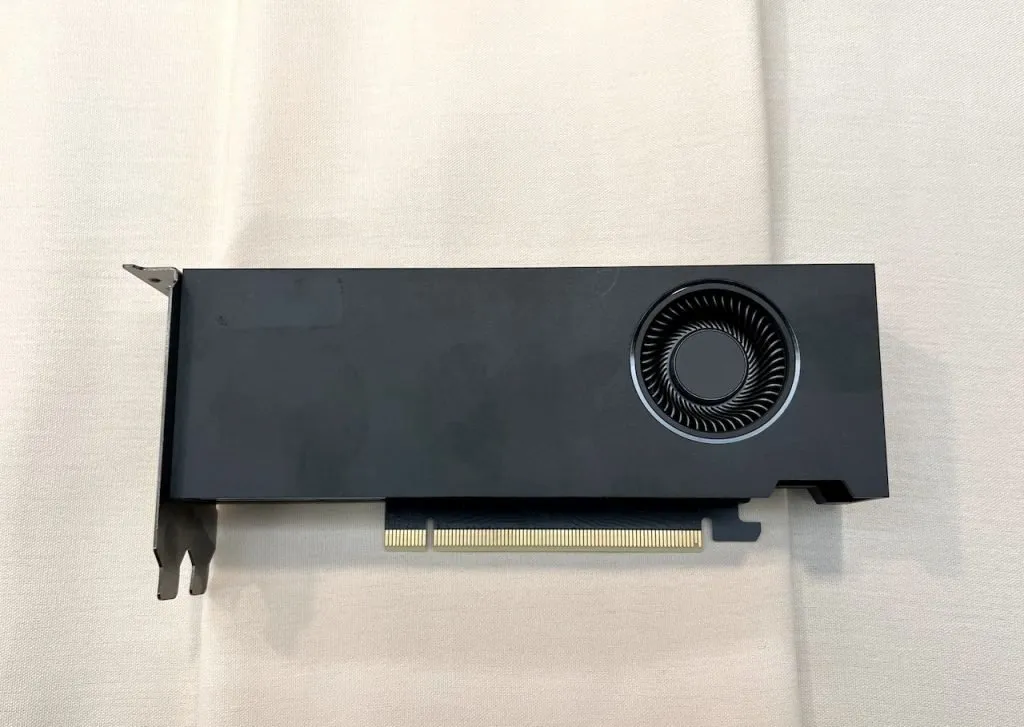
To address this very specific problem, Graid has developed a RAID card (0 to 10) based on standard Nvidia GPUs for workstations working with the NVMe and NVMe over Fabric protocols. “We do absolutely nothing to this board except put this little metal plate on it and plug in the IO ports on the back. We're taking the power from that GPU, and we're also using the AI chip inside the GPU. And we manage to process 19 million IOPS on our PCI 4.0 card with NVMe SSDs, embedded in a server equipped with a third-generation Xeon chip."
Broadcom and Intel as competitors
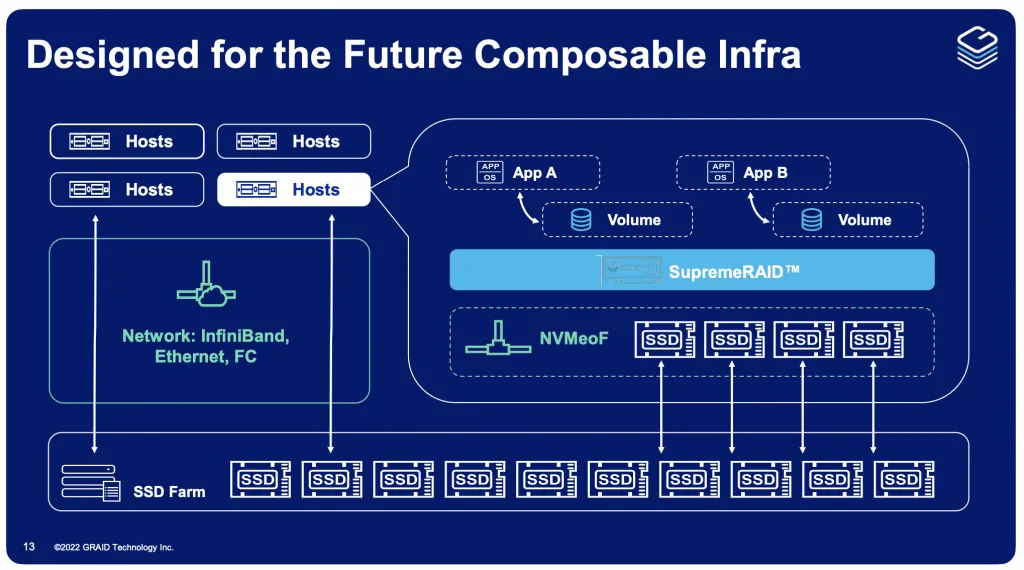
Up to 32 NVMe SSDs are supported by Graid cards, the SupremeRAID™️ SR-1000 (based on Nvidia T1000) on the PCI 3.0 interface ($2,500 HT) and the SR-1010 (based on A2000) using PCI 4.0 ($3,995 excl. VAT). A price that includes the Nvidia GPU card and the software developed by the start-up (perpetual license). A PCI 5.0 version is expected in 2023 with support for the CXL protocol and an opening towards composable infrastructures. “Supreme software is our secret sauce, which sits on a GPU and handles all I/O without CPU intervention. So it does not consume CPU cycles. We call it out-of-path."
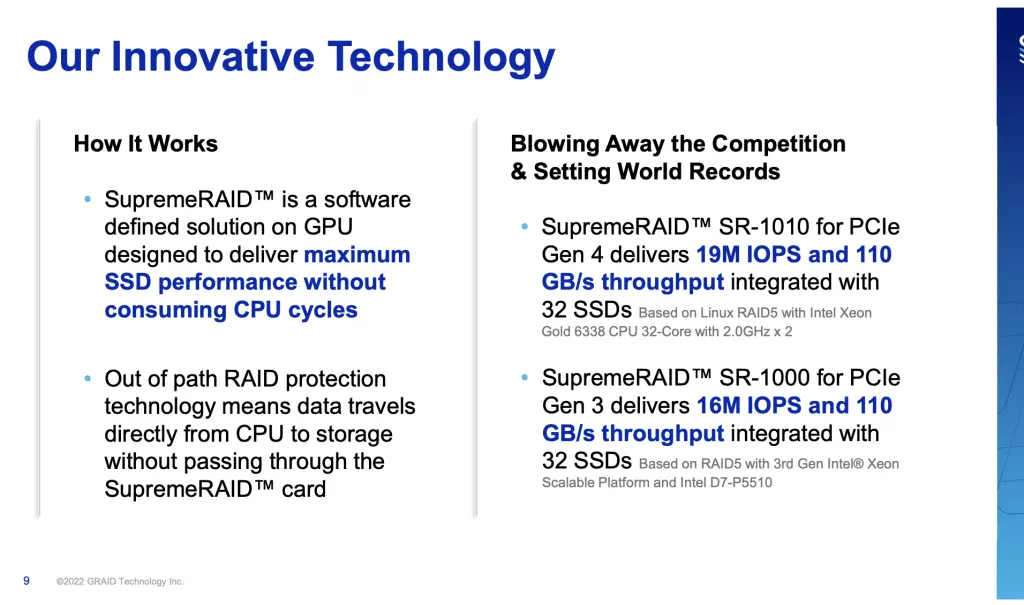
GRAID's competitors include the giant Broadcom and its ASIC-based MegaRaid board originally designed for hard drives. It provides 200,000 IOPS and supports a maximum of four NVMe SSDs. Intel, for its part, offers a VROC software solution associated with its motherboards: it tops out at 21,900 IOPS, according to tests carried out by StorageReview. Graid highlights performance of 750,000 IOPS for its SR-1000 card and 1.5 million for the SR-1010 (in RAID 5). “We manage the local SSDs on the server, but we can also go through the network and we don't care whether it's InfiniBand, Ethernet or Fiber Channel, completes the manager. Asked about the competition with cards equipped with FPGA circuits or DPUs, Tom Paquette believes that “the former are very expensive and very difficult to program, and the latter not powerful enough for our use. We only develop software and use off-the-shelf GPUs like those from NVidia.”
Discussions are also underway with Intel and AMD to leverage their GPUs. “We spoke to Intel at length about their GPU, if it ever comes around. We will definitely port our software to Intel's GPU, to be part of their ecosystem. We think this is an important step for us as a company. We also spoke to AMD who was really interested in our technology and what we can do with a GPU. And they agreed to work on massive GPU which they want to put in an HPC environment."
Arrow and Tech Data as partners
Every six to seven months, Graid pushes out an update to its software, adding features requested by customers. “Our solution is much more flexible than that based on an ASIC or an FPGA, because the rotation of these circuits is not an easy task. And we will soon be ready for native cloud, sometime in 2023."
A French player, OVH, is interested in the solution. Equinix does too, but they do things a little differently, as they serve a multitude of customers. Still in the datacenter part of the roadmap, Kubernetes and VMware will be supported in 2023, and a graphical interface for Windows is also well advanced (not before 2024). “It's not really necessary for Linux because people like our command line,” Tom Paquette told us.
To sell its solution, Graid is working with partners like ARROW North America/EMEA and vendors like WD and Gigabyte, which is also an investor in the start-up. “We are part of WD's co-marketing program, and also part of Intel Network Builders. For its part, ARROW accompanies us in the USA, but also in Europe”. And, Tech Data just joined ARROW. “We will start with them right now in North America. We literally signed with them last week. And we are going through onboarding. Now the part numbers are created in their system. So when someone wants to buy our products, they can do so”. Other discussions are more difficult, with HPE for example, while Lenovo is more interested.
Read it in Networks & Telecoms (French)
About Graid Technology
Chosen by CRN as one of the Ten Hottest Data Storage Startups of 2021 and a 2022 Emerging Vendor in the Storage & Disaster Recovery category, Graid Technology Inc. has developed the world's first NVMe and NVMeoF RAID card to unlock the full potential of enterprise SSD performance. We're headquartered in Silicon Valley, with an R&D center in Taiwan, and are led by a dedicated team of experts with decades of experience in the SDS, ASIC and storage industries. Graid Technology Inc. is redefining performance standards for enterprise data protection: a single SupremeRAID™ card delivers 19 million IOPS and 110GB/s of throughput. For more information on Graid Technology Inc., connect with us on Twitter or LinkedIn.
Additional Resources
News & Resources

Visit Graid Technology at SC26 Booth 1326 in Chicago, November 17–19, to see GPU-accelerated I/O for AI inference and CPU-native data protection with VROC™ by Graid Technology. Stop by to enter our raffle for a pair of Meta glasses.

Storage Review built a shared storage host that gives eight NVIDIA DGX Spark systems access to one parity-protected Solidigm QLC pool, with SupremeRAID™ handling RAID 5 on a GPU. Here is what the testing showed and why it matters for AI labs and enterprise desktop AI fleets.

October 15, 2026
Graid Technology Featured in TechArena’s AI Infrastructure Report, The Integrated Machine
Graid Technology is featured in TechArena’s report The Integrated Machine. Field CTO Randy Kreiser discusses KV cache, inference performance, and why storage has to be designed into the rack from the start.