Contact Us


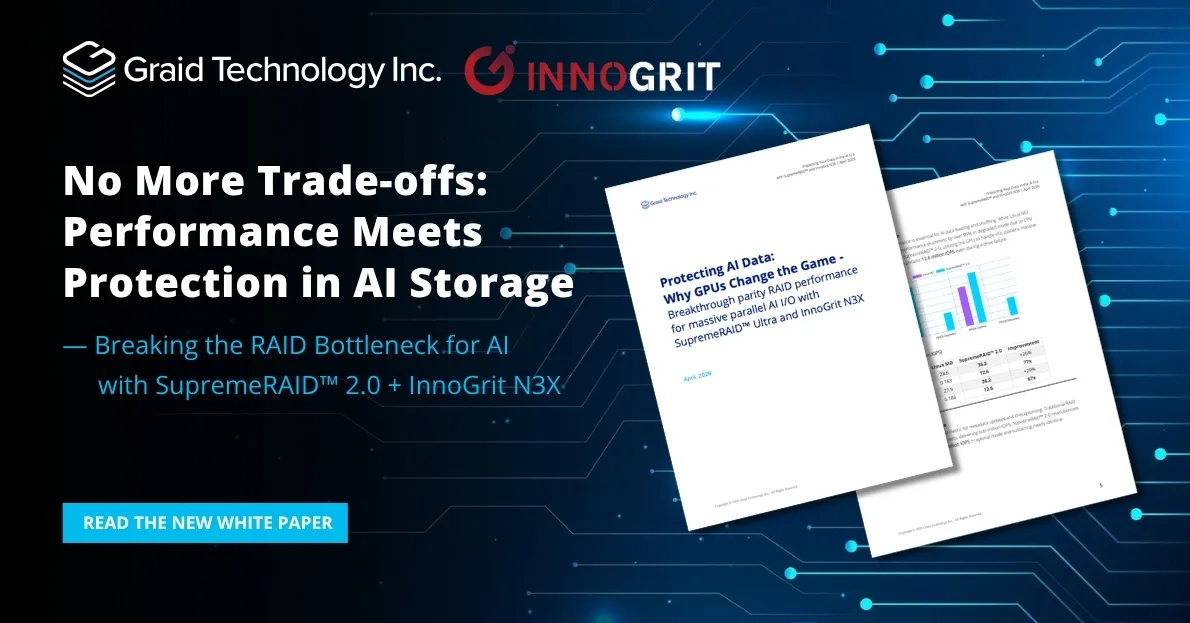
Whitepaper
April 6, 2026
White Paper: Breaking the RAID Bottleneck for AI: SupremeRAID™ 2.0 + InnoGrit N3X
Introduction
AI infrastructure is redefining the limits of storage systems. Unlike traditional enterprise workloads, AI pipelines generate highly parallel, mixed I/O patterns that quickly expose the limitations of CPU-based RAID architectures.
In collaboration with InnoGrit, this whitepaper explores how a GPU-accelerated RAID architecture combined with ultra-low latency NVMe media fundamentally changes storage performance for AI environments.
The Challenge: AI Breaks Traditional Storage
Modern AI workloads demand:
- Massive parallel read operations for training
- Write-intensive bursts for checkpointing and logging
- Continuous metadata access across distributed systems
Traditional RAID—especially parity RAID—struggles under these conditions due to:
- CPU bottlenecks
- degraded-mode performance collapse
- inefficient handling of random writes
This creates a critical gap between GPU compute performance and storage capability.
The Solution: GPU-Accelerated RAID + SLC NVMe
The test platform combines:
- SupremeRAID™ 2.0 (GPU-based RAID engine), powered by the NVIDIA RTX 2000E Ada
- 24x InnoGrit N3X SLC NVMe SSDs
This architecture eliminates the traditional trade-off between data protection and performance, enabling parity RAID at near-native NVMe speeds.
All results demonstrate consistent performance under both optimal and degraded conditions—where traditional RAID typically collapses.
Conclusion
AI demands a fundamentally different storage architecture—one that is parallel, resilient, and efficient.
By combining SupremeRAID™ 2.0 GPU acceleration with InnoGrit N3X SLC NVMe, this solution delivers:
- multi-million IOPS performance
- consistent degraded-mode throughput
- minimal CPU overhead
News & Resources

Defense systems at the rugged edge need compact servers that can protect and process mission data in extreme conditions. See how Trenton Systems uses VROC™ by Graid Technology and SupremeRAID™ in its U.S.-built TRS14-18.5 1U server to combine resilient boot storage with GPU-accelerated data protection.
.jpg)
Graid Technology will showcase SupremeRAID™ AE and Supreme JBOF at Cypher 2026 in Bengaluru, October 7–9. Explore GPU-accelerated NVMe storage and protected KV cache offloading for AI workloads from server to edge.

September 14, 2026
Breaking the KV Cache Inference Wall — Solidigm Data Insights Podcast, Featuring Graid Technology
"You've got a four-lane highway, and to get to your storage, you have to go down to a one-lane bridge." Garrett McKibben joins Solidigm on TechArena's Data Insights podcast to unpack why KV cache overflow is choking AI inference.